Distributed Systems
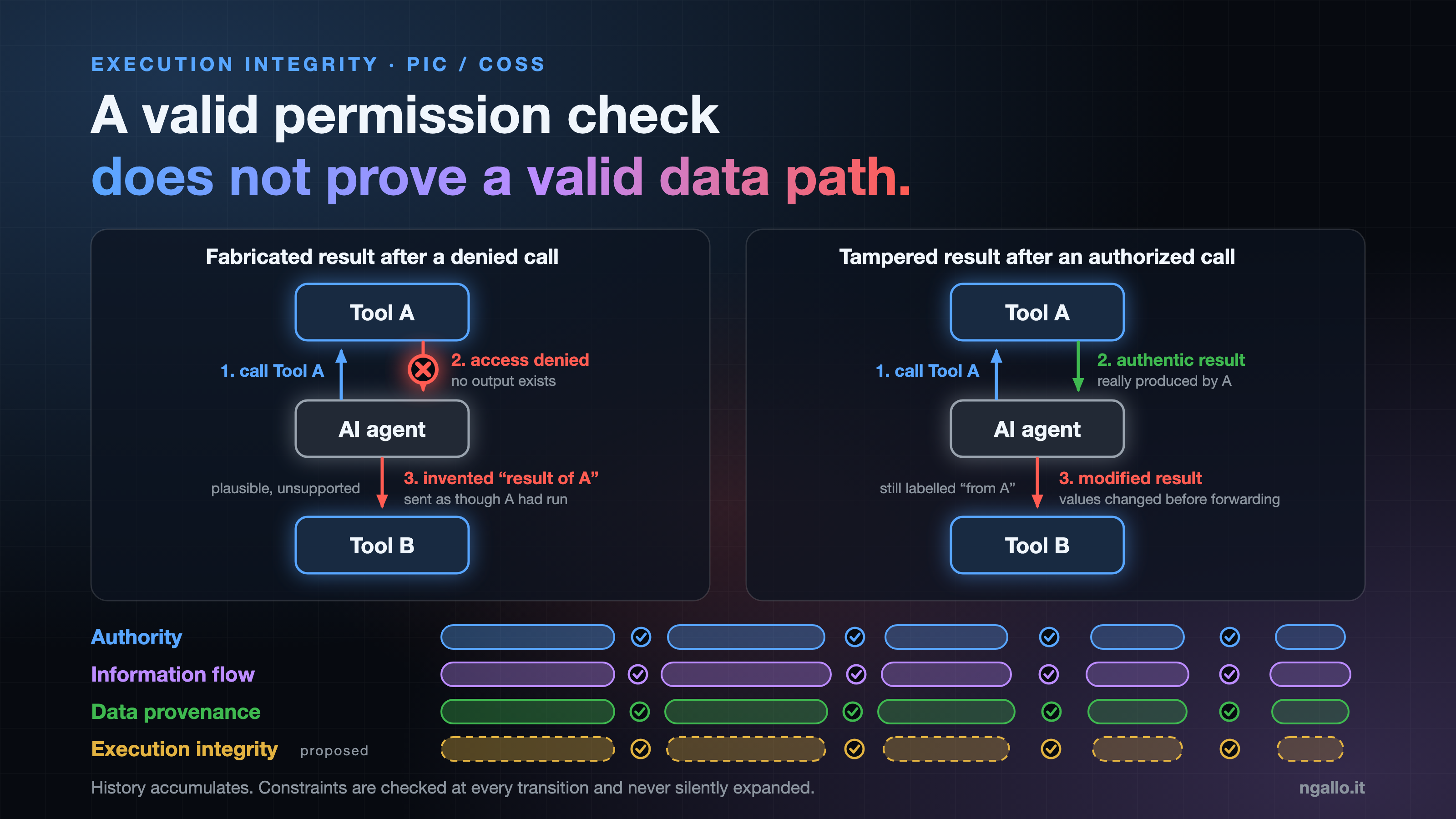
Authorization answers what an executor may do. Execution integrity asks whether the result really came from the permitted execution.
Imagine an AI agent that must call Tool A and pass the result to Tool B. If access to A is denied, the security layer has done its job. Yet the agent can still produce a plausible answer and send it to B as though A had executed. Even when A is available, the agent may change an inconvenient result before forwarding it.
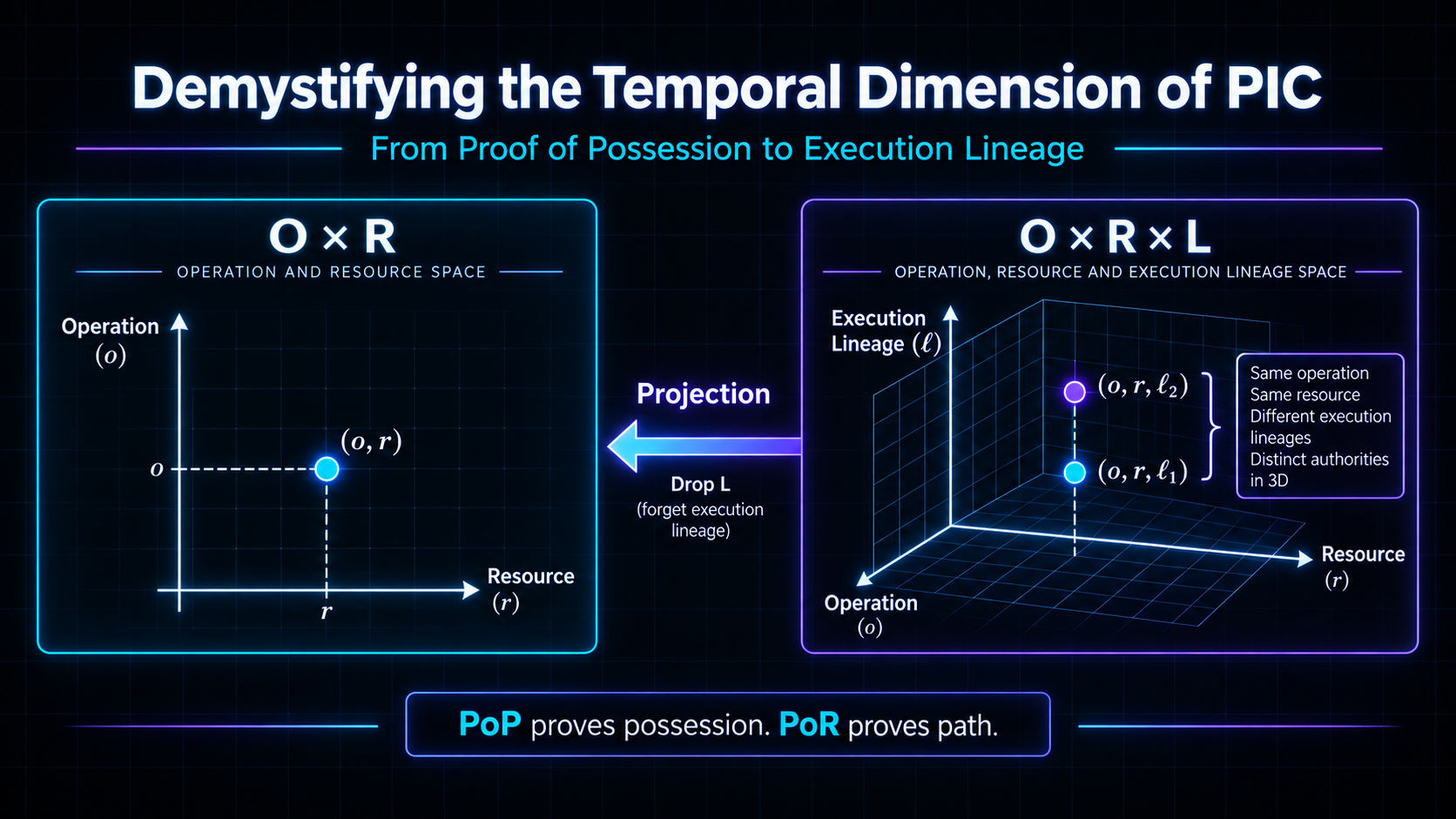
PIC here means Provenance Identity Continuity.
Scope note. This article isolates one part of PIC: its temporal / execution-lineage dimension. PIC is broader than
Land includes additional rules and mechanisms around authority, continuity and verification. The goal here is only to make the temporal axis explicit.
A simple way to understand the temporal dimension of PIC is to start with how authority is created.
On April 20–21, 2026, the 4th International Workshop on Trends in Digital Identity (TDI 2026) takes place in Verona. The workshop program also includes the talk “Provenance Identity Continuity (PIC): Secure Authority Propagation from Human and Non-Human Origins Across Trust Boundaries”, presented by Nicola Gallo and Antonio Radesca (Nitro Agility Srl).
On March 3, 2026, LF Decentralized Trust hosted the session “From Identity-First to Authority Continuity”, presented by Nicola Gallo.
On March 3, 2026, LF Decentralized Trust hosted the session “Trusted AI Agents by Design: From Trust Ecosystems to Authority Continuity”, presented by Nicola Gallo.