Authz
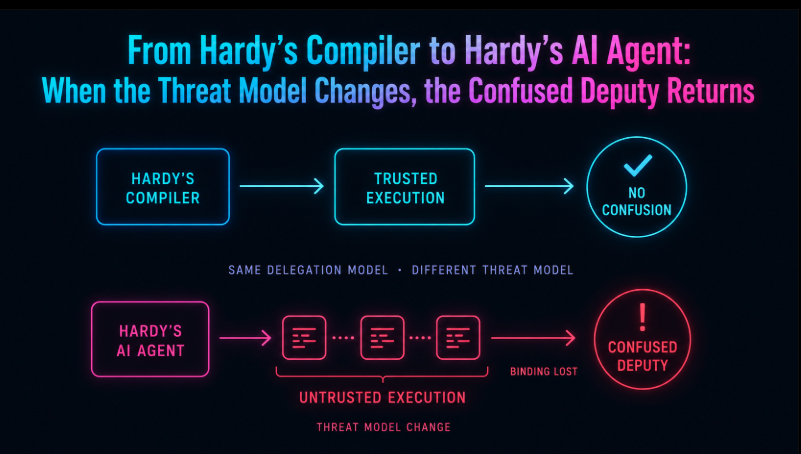
The question. This article examines one narrowly defined security property: whether authority propagated across time and multiple execution boundaries remains verifiably attributable to the concrete execution and request for which it was granted.
The change of question in authority propagation: from actor selection to execution continuity
One scope condition should be kept in mind throughout this article: the following discussion of who concerns only the propagation of authority after initial authentication and authority origination. It addresses what happens when already-established authority is handed off, exchanged, resumed, attenuated, or otherwise continued across a later execution boundary. It does not claim that identity is unnecessary for authentication, initial authorisation, eligibility, accountability, revocation, or other security properties.
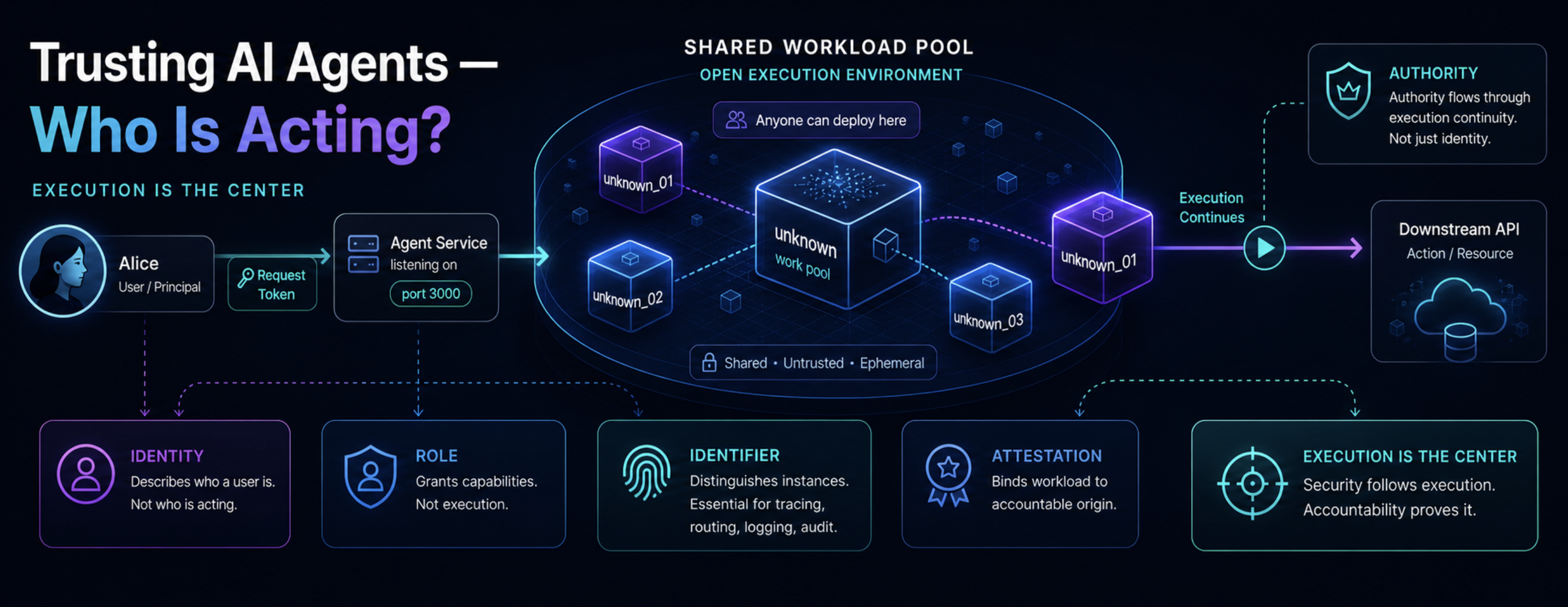
AI agent security is usually approached as an identity problem: the question becomes “what is the agent’s identity, and what is it allowed to do?”. This framing is inherited from decades of human-centric and client-centric authorization design, and it works reasonably well as long as the entity being authorized is stable, persistent, and accountable in its own right. AI agents are none of those things in practice, and the framing produces a steady accumulation of edge cases that identity-centric security models keep trying to patch without changing the underlying assumption.
Over the past couple of years I have written several articles touching on ZTAuth* and PIC. Reading them today, some point in different directions, different angles, different emphasis, different terminology. That is a natural part of how a model evolves when you are building and thinking at the same time.
Ambient Mesh is redefining the Cloud Native service mesh for Zero Trust, whilst
ZTAuth*
completes it with Trust Chains built on Trust Elevation, Trust Levels, and cryptographic signatures. This article explores how these concepts apply to microsegmented and asynchronous workloads.
Single-merchant payments are easy; real commerce is not. The moment users ask an AI agent to buy multiple items from different merchants at the best available prices — and expect all-or-nothing consistency — the problem shifts from a single transaction to multi-merchant coordination. And that’s where today’s token-based models break down.
AI agents bring new security challenges, but also an opportunity to rethink traditional models.
By looking at payments from a decentralized perspective, we can explore privacy-oriented solutions.