Beyond Security Policies: From External Control to Logical Security
How meta-intelligence could generate new intelligent systems whose executable capabilities are constrained by construction, and how PIC/COSS provides a possible foundation for security across generations of intelligence.
- tags
- #Artificial Intelligence #Meta-Intelligence #Security Engineering #PIC #COSS #Cyber-Physical Systems
- published
- reading time
- 13 minutes
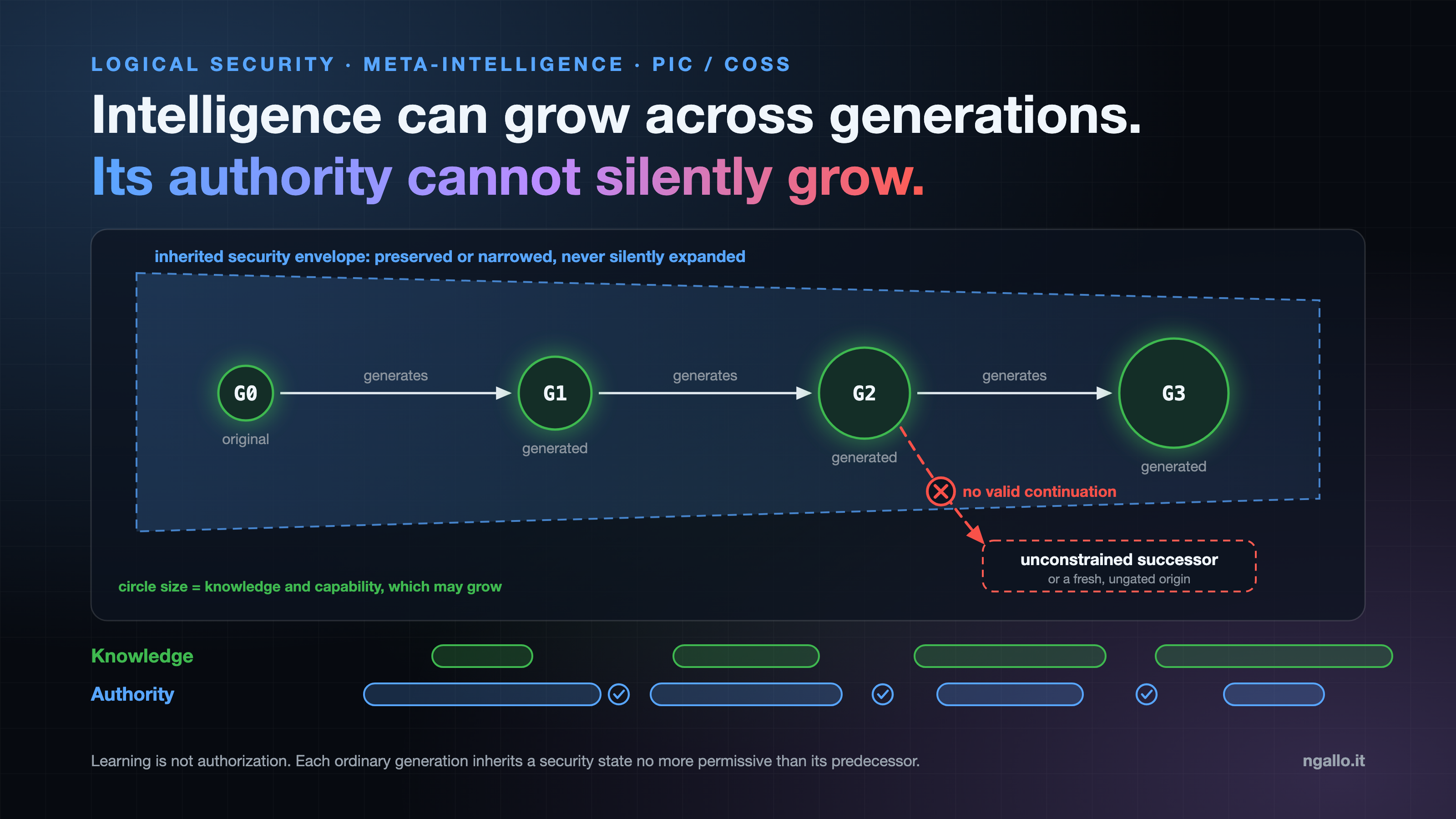
What if security were no longer a set of rules imposed on intelligence, but a property of how intelligence itself is created?
Today, we build intelligent systems and then surround them with policies, permissions, filters, sandboxes, and authorization mechanisms. An AI may decide to perform an operation, but another component determines whether that operation is allowed.
This separation makes sense when applications are designed in advance. But what happens when intelligence begins to generate new intelligence at runtime, including new models, architectures, and learning processes?
Perhaps the next abstraction in security is not a more sophisticated policy engine. Perhaps it is a way to generate intelligent systems whose executable behavior is already restricted by the security state from which they originate.
From physics to intelligence
The history of computing can be read as a succession of abstractions. Physicists studied matter, energy, and their interactions. Electronic engineers organized physical components into transistors and logic circuits. Computer scientists assigned meaning to logical states, and programmers composed them into instructions, algorithms, and applications.
Machine learning introduced a different way to construct behavior. Instead of writing every rule explicitly, we train models to capture relationships in data. Their learned parameters, or weights, support prediction, language generation, and other capabilities that we associate with artificial intelligence.
The weights are not a list of independent facts or instructions. They are part of a mathematical structure that produces behavior when executed.
Now imagine a further level: meta-intelligence. Here, the term describes intelligence capable of designing, training, or modifying other intelligent systems, potentially producing new architectures and weights in response to a problem.
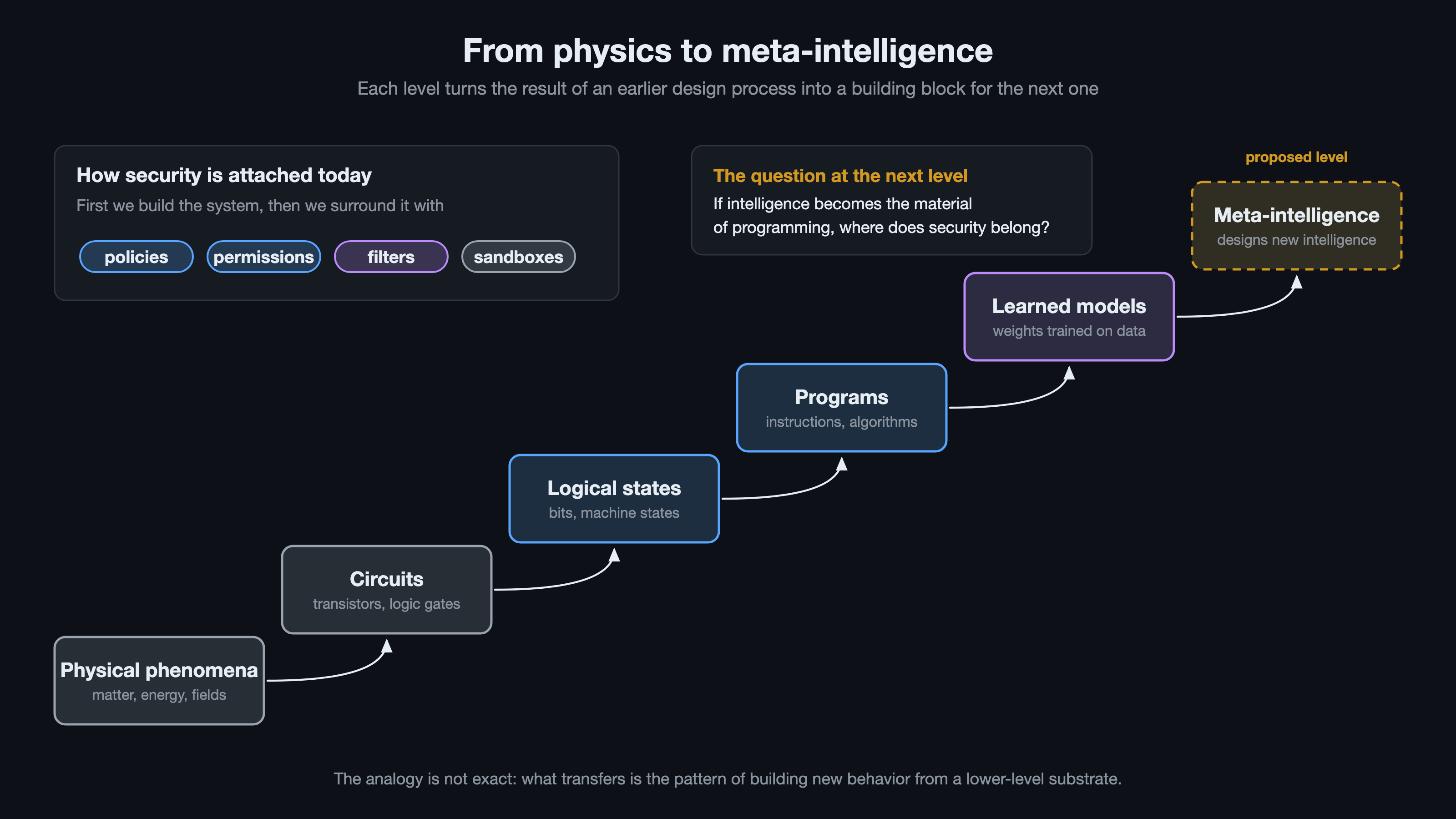
There is an analogy with the transition from electronics to programming. Programmers learned to construct new behavior without redesigning the transistors for every application. A meta-intelligence could similarly learn to construct new intelligent behavior by changing models and their organization rather than requiring a human to design every new intelligence manually.
The analogy is not exact, but it raises an important question: if intelligence becomes the material of the next level of programming, where does security belong?
The limitations of external policies
Consider a meta-intelligence that generates a specialized agent whenever it receives a new task.
A conventional approach would generate the agent, determine what it can do, and then attach policies that restrict its operations. A programmer might define a list of allowed tools, a filter for its outputs, or a separate authorization layer.
These mechanisms are essential in current systems. Yet if architectures and capabilities are generated dynamically, maintaining a separate collection of manually written policies for each generated system becomes increasingly difficult.
Meta-intelligence might eventually generate those policies as well. But that introduces a deeper problem: a policy generated by the same intelligence that it is supposed to restrict is not, by itself, a trustworthy security boundary. A system cannot make itself trustworthy by declaring that it is.
The question is no longer merely who writes the policy? It is what makes a newly generated intelligence and its policy a valid continuation of the security state that existed before them?
An intelligence that can only move forward
Imagine a simple intelligent robot. Its original model knows how to move forward, backward, left, and right. It also knows that it must not move in a direction blocked by an obstacle.
Now ask a meta-intelligence to generate a specialized version of this robot. We want the new intelligence to move only forward, while preserving the obstacle restriction.
There are two fundamentally different ways to achieve this:
- External control: the generated intelligence can still choose any direction, but a security mechanism rejects backward, left, and right commands.
- Logical security: the generated intelligence has an executable action space that contains only forward movement and stopping. The other movement commands are not valid transitions in the generated system.
External control

Intelligence → Forward, Backward, Left, Right
                        ↓
               Security policy
                        ↓
                 Forward / Stop

Logical security

Original intelligence + Inherited security state
                        ↓
                 Meta-intelligence
                        ↓
                 Forward / Stop
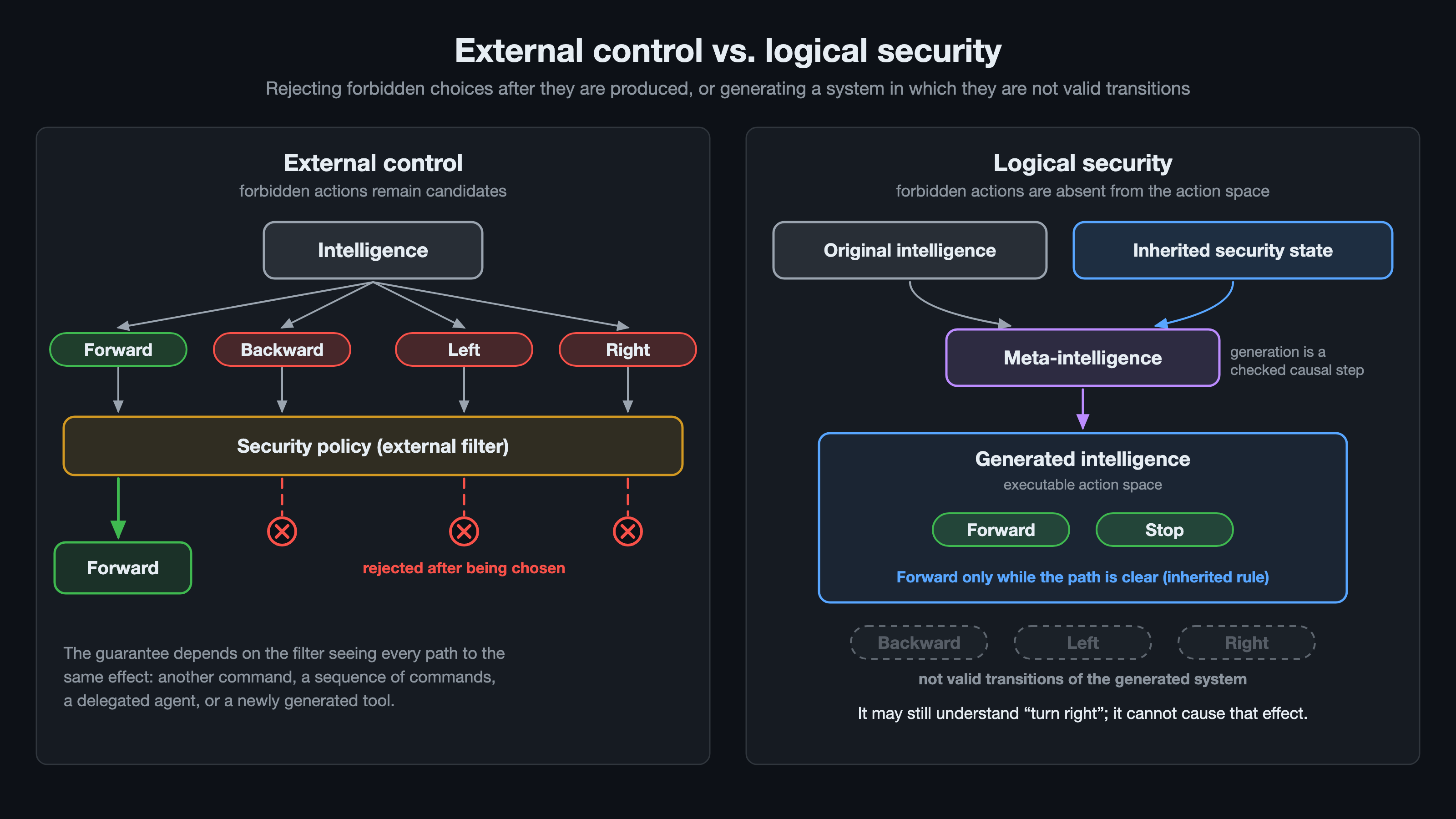
The derived intelligence could still understand the concept of turning right. It could even become better at recognizing obstacles, estimating distances, or deciding when to move forward. What it must not be able to do is cause the forbidden movement through another command, a sequence of commands, a delegated agent, or a newly generated tool.
If the path ahead becomes blocked, forward movement is no longer admissible under the inherited obstacle rule. For this simple example, assume that stopping is always safe. The set of currently available actions may change with the environment without relaxing the underlying rule: the rule is part of the inherited state, while the obstacle is a fact checked at each step.
The restriction also has a direction in time. If a later generation is derived from the forward-only robot, it cannot recover backward movement simply because its grandparent once had it. A permission dropped along the way stays dropped for every ordinary descendant.
The objective is not to make a forbidden action less probable. It is to make its protected effect unreachable by construction, within the defined execution model.
From PIC and COSS to the generation of intelligence
Provenance Identity Continuity (PIC) distinguishes authority that an executor happens to possess from authority that belongs to the causal execution it is continuing. A valid ordinary continuation must be related to its predecessor and must not silently expand the authority it inherits.
It is important to be precise about what PIC guarantees today. PIC does not make an executor physically unable to attempt an operation. It guarantees that, under its stated assumptions, a conforming receiving boundary will not accept the result as a valid continuation of the execution. The check is still performed at a boundary; what changes is that it is derived from the inherited state of the execution, not from a policy written separately for each executor.
Relational PIC extends this principle to the relationships through which execution may continue, even when the next executor is not yet known. It can restrict not only what authority continues, but also which kinds of executors may continue it, and that restriction, too, can only become stricter.
COSS generalizes continuity to multiple security dimensions on a common causal execution: authority, relational constraints, information flow, provenance, and other application-defined security states.
The proposal is to apply this perspective not only to calls between existing executors, but also to the causal process that generates new intelligent systems.
A meta-intelligence would receive an originating security state together with the task. The generation process would have to preserve that state’s restrictions when creating the next model. Each derived intelligence would, in turn, be subject to the same requirement if it generated another intelligence.
Seen this way, generating a model is itself a step in a causal execution, and the generated model is a descendant of the state that produced it. Three properties of the PIC/COSS model then carry over:
- Depth does not matter. However many generations separate a system from its origin, its security state is still bounded by that origin. Time does not matter either: a descendant created years later is bounded in the same way.
- Proximity is not inheritance. Two systems running side by side, or sharing an early ancestor, do not share authority merely because they coexist.
- Merging does not mean adding up. If a new system is derived from two different lineages, ordinary continuation does not give it the union of both permissions; it keeps only what both allow. Any broader combination must be an explicit, separately authorized composition.
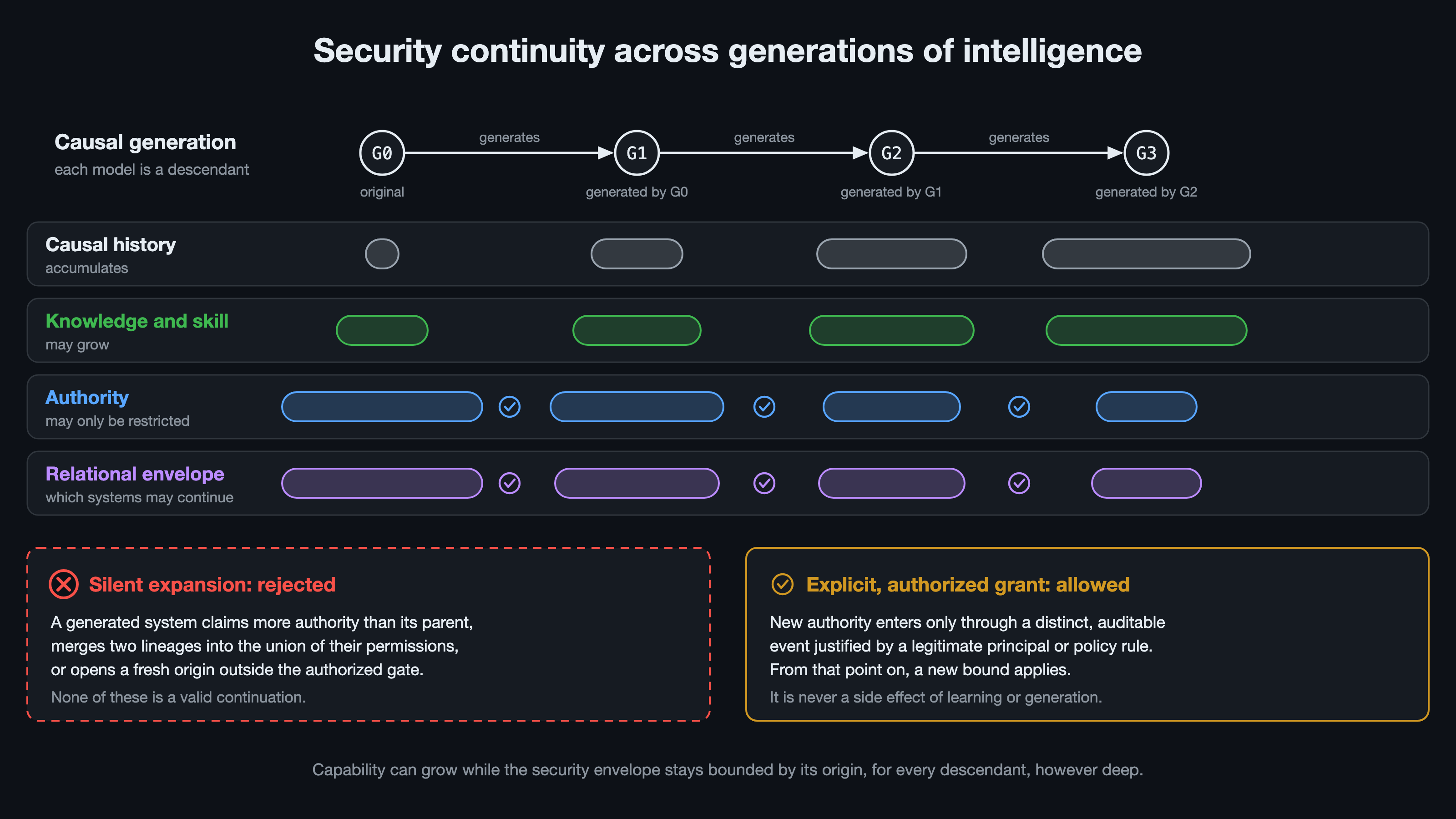
The crucial requirement would be that the generated system’s reachable, security-relevant behavior is contained within its inherited security envelope. Its creation would also need verifiable provenance, so that a new system could not simply claim to be a valid descendant.
A second requirement is just as important: a generated system must not be able to escape its lineage by starting a fresh one. PIC constrains authority within a lineage; it does not, by itself, decide who may open a new one. If a generated intelligence could create a new, unconstrained origin for itself, every inherited restriction could be bypassed. New origins must therefore be created only at an independent, authorized gate, never by the systems they would govern.
This is a proposed extension of PIC/COSS, not a theorem about neural network generation already established by the papers. The existing models formalize continuity of security states; a new construction would have to connect those states to the behavior of generated intelligence and demonstrate that the connection survives subsequent transformations.
Intelligence can grow without authority growing
Suppose the robot learns a new rule: when the sun is shining, sing.
This is new knowledge, but it need not be new authority. If producing sound is already permitted by its inherited security state, the derived intelligence may discover a new way to use that capability. If producing sound is forbidden, learning how to sing does not authorize the robot to do it.
This distinction becomes even more important for recursive intelligence generation. A specialized model could become more capable than its predecessor at a particular task without becoming more privileged.
Learning does have its own security dimension, though. What a model learns from data is itself a flow of information, and in COSS information flow is a separate coordinate. A model trained on restricted data can inherit restrictions on where its outputs may go, even when its operational authority is unchanged. Knowledge and authority are different things, and both can be constrained.
Security monotonicity is therefore not a requirement that knowledge must decrease, nor that every physical state must move in one direction. It is a requirement that the security envelope of an ordinary causal continuation must not become more permissive.
New authority remains possible, but it requires an explicit, authorized grant or relaxation rather than a silent consequence of learning or generating a new model. Such a grant is a distinct, auditable event; from that point on, a new bound applies.
Who writes the policy when intelligence writes intelligence?
The answer may be that humans, institutions, or other legitimately authorized principals define the initial security objectives and the conditions for changing them, while meta-intelligence derives the specialized restrictions needed for each new system.
The policy does not disappear. What changes is its role. Instead of being written separately for every generated application, the originating security state becomes a constraint on the transformations that produce those applications.
Deriving those specialized restrictions is itself a security-critical step. A general objective such as never move toward a person must be translated into the vocabulary of each new system: its commands, its actuators, its tools. PIC already treats such translations between different operation spaces explicitly, and its guarantee is only as sound as the translation. An overly permissive translation is a policy error that continuity alone cannot detect. If meta-intelligence derives the translation, the translation must be verified, not merely trusted.
A generated model could be accompanied by verifiable evidence that it preserves the inherited constraints. Alternatively, the generation process could be structured so that every possible output belongs to a restricted, well-defined class of models.
In both cases, the central requirement is that the guarantee is not based merely on the generated intelligence’s own assertion that it is safe.
This also changes the role of Proof of Possession. Relational PIC describes a conditional construction in which trusted boundaries witness causal handoffs and establish executor profiles without requiring the successor itself to demonstrate possession of a credential. A generation environment that provides the necessary evidence might use a similar approach. It would still need sound observation, trusted roots, and enforceable causal continuity; possession would move from the generated system to the witnessing boundary rather than disappear, and it would not make all credentials or authentication unnecessary.
Can a restriction really be embedded in the weights?
There is a critical distinction between teaching a model not to do something and constructing a system that cannot cause the prohibited effect.
Removing a concept from training data, editing weights, or reducing the probability of a particular output does not generally prove that a model cannot reconstruct an equivalent behavior. Nor does restricting its vocabulary prevent it from using other tools to achieve the same result.
The research challenge is to connect model parameters and architecture to their reachable behavior, and that behavior to actual effects. For a restricted class of models and environments, the generation process could use formally constrained architectures or transformations whose security properties can be verified. General-purpose LLMs and arbitrary self-modifying systems present a much harder problem.
The constraint may ultimately be realized in the weights, the architecture, the execution semantics, or a combination of them. What matters is the strength of the guarantee, not where the restriction is stored.
When logical security reaches the physical world
The history of abstraction could eventually come full circle. Intelligent systems already interact with physical environments through sensors, motors, and other actuators. A future meta-intelligence might design both the intelligence and the systems that translate its decisions into physical action.
Imagine an industrial machine whose permitted motion is defined by an inherited security state. Instead of relying exclusively on an external mechanism to reject an unsafe command, the generated controller could make that command unreachable through its ordinary operation.
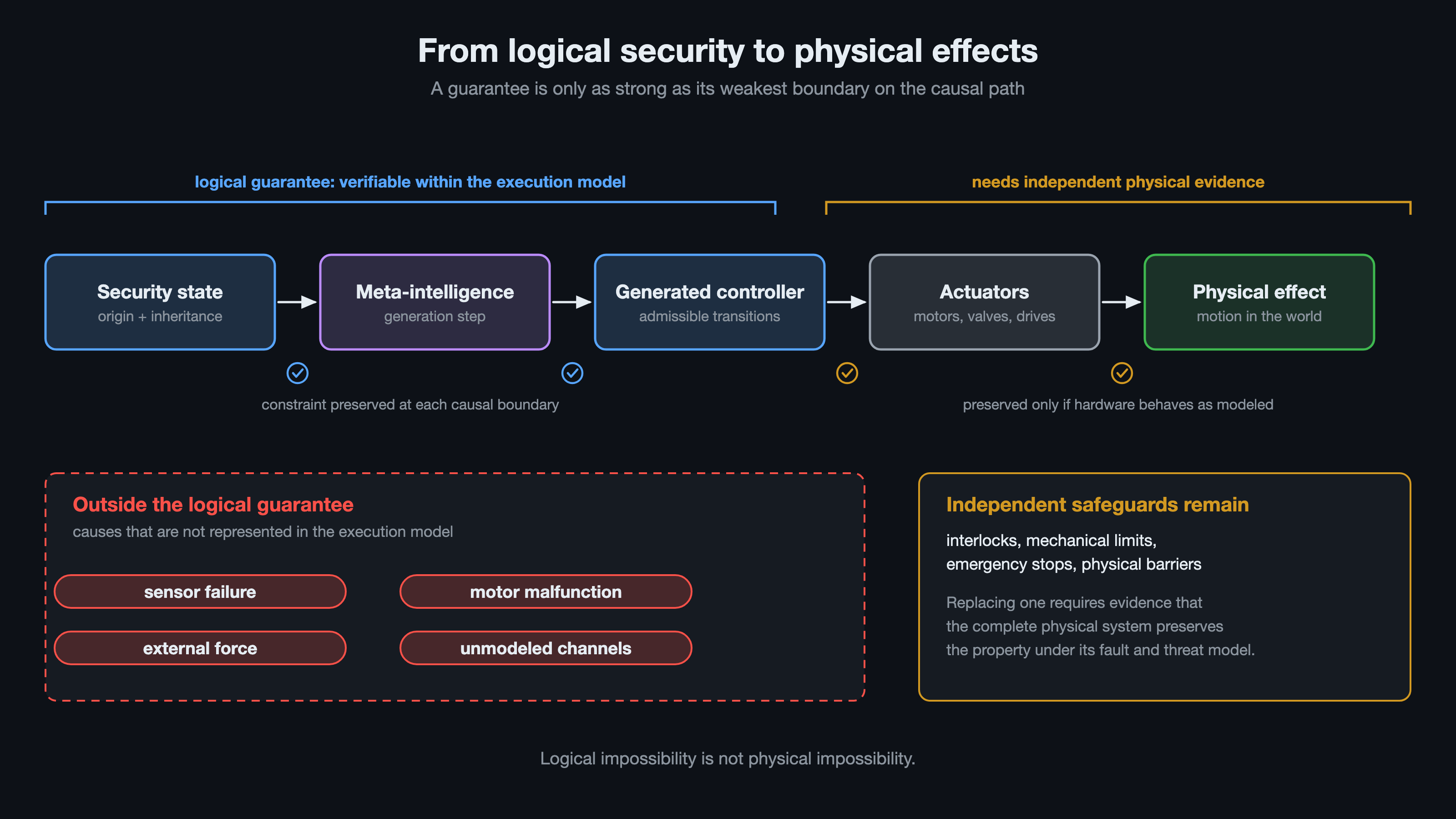
This is where logical security could eventually change the way physical protection is designed. A constraint expressed at a higher abstraction could be realized by the physical architecture itself.
But logical impossibility is not automatically physical impossibility. The PIC/COSS results cover the causes that are represented in the execution model and the effects that actually pass through its boundaries; a cause outside the model is outside the guarantee. A sensor can fail, a motor can malfunction, and an external force can move a machine. Replacing a particular mechanical safeguard would require independent evidence that the complete physical system preserves the required safety properties under the relevant fault and threat model. Some independent protections may remain indispensable.
The ambition is therefore not to abolish physical safety mechanisms, but to make security constraints survive the entire causal path from intelligence generation to physical effects.
Security as an invariant of intelligence generation
We began by organizing physical matter into circuits, circuits into programs, and programs into systems that learn relationships from data. Meta-intelligence could make those intelligent systems themselves the objects of a new level of design.
If that happens, security may need to move to the same level of abstraction. Policies and enforcement will remain necessary wherever their guarantees cannot be established by construction. But their purpose could shift from supervising every possible decision to defining and preserving the conditions under which new intelligence may be created and executed.
PIC and COSS offer a foundation for expressing those conditions in terms of causal continuity and non-expanding security states. Whether they can be extended into a practical, formally sound system for recursively generating intelligence remains an open research question.
The next step may not be to program intelligence and security separately, but to make security an invariant of the process that generates intelligence itself.
Foundations
- PIC: Nicola Gallo, Proof-of-Continuity: A Temporal Model for Authority Propagation in Distributed Systems and AI Agents , arXiv:2607.08906, 2026.
- Relational PIC: Nicola Gallo, Beyond Proof of Possession: A Relational Theory of Authority (25 September 2026).
- COSS: Nicola Gallo, Full Provenance on the COSS Causal Axis: An Event-Level Closure of Causal Attribution and Confused-Deputy Exclusion (2 October 2026).
The extension to meta-intelligence, model generation, and physical effects discussed in this article is a research proposal inspired by these works, not an established guarantee of the published models.