The Agentic Feedback Loop: From Adaptive Intelligence to Governed Execution
AI agents change software when they stop merely producing answers and begin pursuing outcomes in a changing world. This article explores the agentic feedback loop, why deterministic control still matters, why execution becomes a first-class architectural object, and how security, evidence, residual-risk observability and governance can create economic value around autonomous systems.
- tags
- #Ai Agents #Agentic Ai #Feedback Loops #Systems Thinking #Outcome-Oriented Programming #Execution #Security #Governance #Risk #Insurance #Runtime #Ai Architecture
- published
- reading time
- 23 minutes
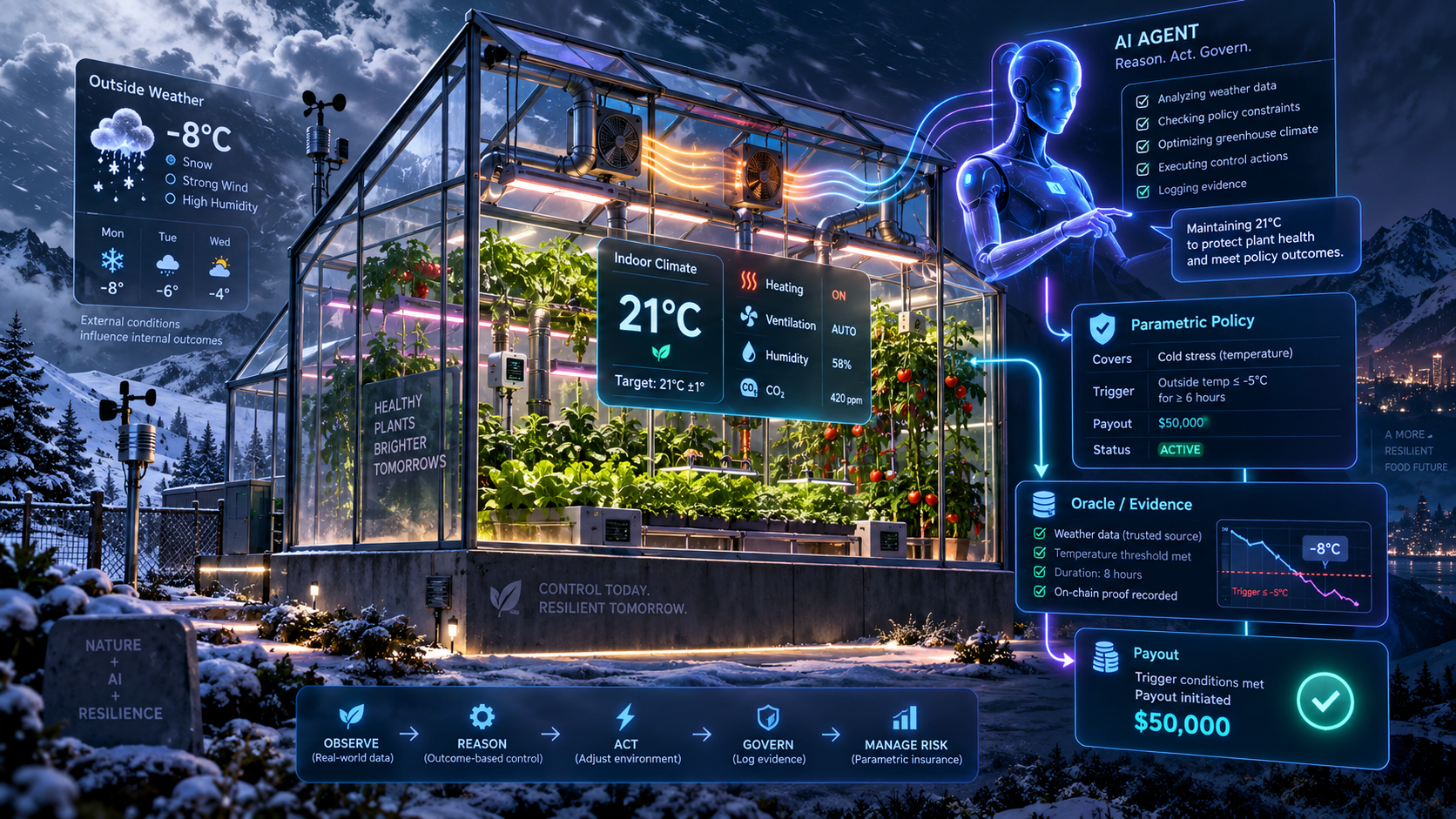
Imagine a commercial greenhouse containing a crop worth EUR 500,000.
Temperature is one of the variables that determines whether that crop survives.
Too cold for too long and growth may be damaged.
Too hot and the crop itself may be at risk.
The greenhouse therefore has deterministic capabilities such as:
read_internal_temperature()

read_external_weather()

adjust_heating()

control_ventilation()
Its desired outcome is simple to express:
OUTCOME

Maintain greenhouse conditions
inside the safe operating range.
For simplicity, assume the desired temperature range is:
20°C - 22°C
But the greenhouse is not only a physical system.
It is also an economic asset.
And that asset may be insured.
Start With the Economic Risk
Imagine, as an architectural example, that the greenhouse is covered by a parametric insurance policy.
A parametric policy can define a measurable condition in advance.
For example:
INSURED ASSET
    |
    v
Commercial greenhouse crop
Value: EUR 500,000


PARAMETRIC CONDITION
    |
    v
Internal temperature > 30°C
for more than 20 consecutive minutes


TRUSTED ORACLE
    |
    +---- greenhouse sensors
    |
    +---- environmental data
    |
    +---- trusted timestamps
    |
    v
Did the insured condition occur?


PAYOUT
    |
    v
Predetermined amount or formula
subject to policy terms
The values are illustrative.
The architectural distinction is what matters.
The policy defines what physical event matters.
The oracle provides trusted evidence about whether that event occurred.
But the oracle tells only part of the story.
It may tell us:
The greenhouse exceeded 30°C
for twenty minutes.
It does not necessarily tell us:
What did the operating system know?

When did it detect the problem?

What decision was made?

Which safeguards were active?

Was escalation required?

What action was actually executed?
Those are questions about execution.
Oracle Evidence and Execution Evidence
These are different kinds of evidence.
+--------------------------+       +---------------------------+
|      ORACLE EVIDENCE     |       |    EXECUTION EVIDENCE     |
+--------------------------+       +---------------------------+
|                          |       |                           |
| What happened?           |       | How was it managed?       |
|                          |       |                           |
| temperature              |       | observation               |
| weather                  |       | decision                  |
| duration                 |       | proposed action           |
| timestamp                |       | safeguards                |
| insured trigger          |       | escalation                |
|                          |       | accepted effect           |
|                          |       | observed result           |
+--------------------------+       +---------------------------+
             |                                   |
             +----------------+------------------+
                              |
                              v
                    MORE COMPLETE VIEW
                       OF THE RISK
Oracle evidence describes the world.
Execution evidence describes how the system operated in that world.
That distinction also matters for insurance.
The oracle can establish whether the contractual parameter was triggered.
Execution evidence answers a different question:
Was the developing condition detected?

Were safeguards still active?

Did the system attempt mitigation?

Did it follow its expected governance path?

Was escalation performed?

What actions actually reached the system?
Execution evidence does not replace the contractual trigger.
Its value is different.
It provides evidence of how the insured risk was actually managed before, during and after the event.
To understand why this matters for AI Agents, however, we first need to look at the feedback loop.
Before AI: the Closed Loop
We do not need an AI Agent to control temperature.
A conventional thermostat already implements a closed-loop system.
Suppose the sensor reads:
18°C
while the desired range is:
20°C - 22°C
A deterministic controller may apply:
if temperature < 20°C:
    increase heating
Then it observes again.
18°C
  |
  v
increase heating
  |
  v
19°C
  |
  v
increase heating
  |
  v
21°C
The basic structure is:
OBSERVE
   |
   v
COMPARE <--------- DESIRED STATE
   |
   v
DECIDE
   |
   v
ACT
   |
   v
WORLD
   |
   +----------> OBSERVE
The controller does not assume that an action produced the expected result.
It observes the world again.
It compares actual state with desired state.
Then it corrects.
That is feedback.
A Closed Loop Is Not Automatically Agentic
A controller can be extremely sophisticated without being an AI Agent.
It can use:
temperature sensors

external temperature

thermal models

weather forecasts

optimization

adaptive coefficients
A Model Predictive Controller can predict future behaviour, optimize a trajectory over a time horizon, execute part of that trajectory, observe the result and calculate again.
That is already powerful.
When the problem is well modelled, the state is structured and the possible actions are known, a deterministic controller may be exactly what we want.
It may be cheaper.
More predictable.
More stable.
And easier to verify.
So the value of an LLM is not simply:
“It can read the weather forecast and choose a better heating percentage.”
A good deterministic controller can already do that.
The interesting agentic problem begins when the model, context or space of possible strategies is no longer completely pre-authored.
Where the Agent Starts to Add Value
Suppose the greenhouse controller predicts:
expected:
20.5°C

observed:
18.6°C
Something is wrong.
A deterministic controller can compensate.
But an Agent can investigate a broader question:
Why is the system behaving differently from the expected model?
It may inspect heterogeneous sources:
temperature sensors

weather forecast

ventilation state

maintenance history

equipment alerts

energy constraints

agronomic instructions

operator notes
Perhaps it discovers:
Heating unit:
    healthy

External temperature:
    colder than predicted

Ventilation:
    vent 3 appears partially open

Maintenance log:
    actuator inspection overdue
Now the decision is no longer simply:
increase heating by another 10%
The Agent can reason across different classes of action:
increase heating

reduce ventilation

inspect vent actuator

request maintenance

notify the agronomist

change environmental strategy
This is a different problem.
KNOWN MODEL
+
KNOWN STATE
+
KNOWN ACTION SPACE
        |
        v
DETERMINISTIC CONTROL
versus:
INCOMPLETE MODEL
+
HETEROGENEOUS CONTEXT
+
OPEN STRATEGY SPACE
        |
        v
AGENTIC REASONING
That is where adaptive intelligence becomes interesting.
The Agentic Feedback Loop
The desired outcome remains stable.
The path toward it does not have to be.
                   DESIRED OUTCOME
                          |
                          v
                     +---------+
                     | COMPARE |
                     +----+----+
                          ^
                          |
                       OBSERVE
                          |
                          v
                        REASON
                          |
                          v
                    PLAN / DECIDE
                          |
                          v
                         ACT
                          |
                          v
                        WORLD
                          |
                          +---------> OBSERVE
Each stage has a different role.
OBSERVE

What is happening?


EVALUATE / COMPARE

Where is the current state
relative to the desired outcome?


REASON

Why is there a gap?

What changed?

What alternatives exist?


PLAN / DECIDE

What should happen next?


ACT

Propose an effect on the world.
The important point is that replanning is not a second loop.
When new evidence arrives, the Agent enters the same loop again.
OBSERVE
   |
   v
EVALUATE
   |
   v
REASON
   |
   v
DECIDE
   |
   v
ACT
   |
   v
WORLD
   |
   +----------> OBSERVE
A different observation can produce a different strategy.
That is adaptation.
The Plan Is No Longer the Program
Traditional software often assumes that most of the future path is defined before execution begins.
Step 1
   |
   v
Step 2
   |
   v
Step 3
   |
   v
Step 4
Agentic execution can look different.
World W0
   |
   v
Decision A1
   |
   v
World W1
   |
   v
Decision A2
   |
   v
World W2
   |
   v
Decision A3
Each new state may contain information that did not exist when execution started.
The Agent may discover a failed actuator.
A new forecast.
A maintenance alert.
A conflicting sensor.
A new instruction from an operator.
The outcome remains relatively stable.
The path evolves.
The Agent does not merely execute a plan. It continuously constructs the next part of execution from feedback.
There Are Actually Three Loops
A physical agentic system should not have one giant AI loop controlling everything.
It is better understood as several loops operating at different timescales.
1. The Fast Deterministic Control Loop
Sensor
  |
  v
DETERMINISTIC CONTROLLER
  |
  v
Actuator
  |
  v
WORLD
  |
  +----------> Sensor
This loop may run every second or every millisecond.
It can own:
setpoints

rate limits

physical interlocks

hard safety envelopes

emergency shutdown
This loop continues even when the AI Agent is asleep.
2. The Agentic Adaptation Loop
OBSERVE
   |
   v
EVALUATE
   |
   v
REASON
   |
   v
CHANGE STRATEGY
   |
   v
WAIT
This loop operates at a higher semantic level.
It may run every few minutes, every hour, or only when something meaningful changes.
The Agent may decide to:
change strategy

request maintenance

inspect another system

change target parameters

ask another Agent

notify a human
The Agent does not need to control the physical process every millisecond.
It adapts strategy while deterministic systems continue operating below it.
3. The Governance Loop
EXECUTION EVIDENCE
        |
        v
    RISK STATE
        |
        v
    GOVERNANCE
        |
   +----+----+
   |         |
continue   escalate
constrain  deny
This loop may activate when:
risk increases

authority is insufficient

evidence is missing

safety limits are approached

human accountability is required
The three loops have different responsibilities.
FAST

physical control
milliseconds / seconds


ADAPTIVE

Agent reasoning
minutes / hours / events


GOVERNANCE

risk / authority / accountability
exceptions / decisions
WAIT Does Not Mean the System Stops
Suppose the greenhouse is stable at:
21°C
The Agent can enter:
WAIT
That means:
stop AI reasoning

consume no inference

persist what is necessary

wait for a meaningful trigger
It does not mean the greenhouse stops being controlled.
AI AGENT
   |
   | WAIT
   v
 sleeping


DETERMINISTIC CONTROL
   |
   | still running
   v
greenhouse remains controlled
The Agent can sleep.
The control system cannot.
What Wakes the Agent?
The Agent should not wake every time a sensor changes by 0.1°C.
That would simply recreate a busy loop with expensive inference.
Wake-up conditions should be generated by deterministic mechanisms.
For example:
temperature leaves permitted band

forecast changes materially

sensor disagreement exceeds threshold

equipment alarm appears

maintenance state changes

timer expires

external event arrives
These rules may live in:
industrial controllers

application monitoring

rules engines

Agent frameworks

domain-specific event processors
They do not belong inside the generic execution proxy.
For example, a greenhouse application may emit:
temperature.out_of_band
AEF does not need to know why the temperature is out of range.
It only needs to carry the event to the correct execution.
The domain owns meaning.
The execution layer carries the occurrence.
The Logical Loop Is Not a Permanent Process
An Agent may operate like this:
08:00

Occurrence 1

observe
reason
propose

WAIT
Then:
09:15

temperature.out_of_band

Occurrence 2

observe
reason
propose

WAIT
Then:
13:40

maintenance alarm

Occurrence 3

observe
reason
propose
So:
logical feedback loop

!=

one permanently running AI process
The loop may span:
processes

services

messages

machines

humans

minutes

hours

days
That is where execution itself becomes important.
Execution Becomes a First-Class Object
If an Agent acts now, sleeps, wakes because of an event, calls another service, waits for a human and then continues tomorrow, what connects all of those moments?
Not necessarily one process.
Not one thread.
Not one LLM conversation.
The connecting object is the execution.
Desired Outcome
      |
      v
Occurrence 1
      |
      v
World changes
      |
      v
Occurrence 2
      |
      v
External service
      |
      v
Occurrence 3
      |
      v
Human decision
      |
      v
Occurrence 4
Once execution crosses systems and time, generic infrastructure becomes useful for:
execution identity

occurrence identity

correlation

routing

persistence

retry

timeout

delivery

checkpointing

security context

evidence
These are execution concerns.
They do not require understanding greenhouse agronomy.
Enter Permguard Agentic Execution Fabric (AEF)
This is the role of Permguard Agentic Execution Fabric (AEF).
AEF is a generic execution layer around AI Agents.
It can work with different Agent frameworks, different companies and completely different industries.
For that reason, one principle is critical:
AEF must not contain application or business logic.
The Agent owns meaning.
Domain systems own domain rules.
Industrial controllers own physical control.
Risk and governance systems own domain-specific decisions.
AEF owns the execution around them.
+----------------------------+
|       AI AGENT / APP       |
+----------------------------+
| outcome                    |
| domain meaning             |
| diagnosis                  |
| reasoning                  |
| strategy                   |
| business decisions         |
+-------------+--------------+
              |
              v
+----------------------------+
|          AEF EDGE          |
+----------------------------+
| generic execution proxy    |
| trusted execution state    |
| security boundary          |
| authority virtualization   |
| continuity                 |
| correlation                |
| routing / transport        |
| persistence                |
| execution evidence         |
| audit / observability      |
+-------------+--------------+
              |
              v
+----------------------------+
|     EXTERNAL SYSTEMS       |
+----------------------------+
| controllers                |
| APIs                       |
| tools                      |
| message systems            |
| other Agents               |
| governance services        |
| physical systems           |
+----------------------------+
AEF does not contain logic such as:
if temperature > 22°C:
    reduce heating
It does not decide:
23°C is dangerous

the crop needs more humidity

the forecast requires cooling

maintenance should be called
That knowledge remains outside AEF.
The Edge Is a Proxy, Not a Business Brain
A useful mental model is:
AI Agent
    |
    | proposal / event / call
    v
+------------------------+
|       AEF EDGE         |
+------------------------+
| execution proxy        |
| security boundary      |
| authority continuity   |
| correlation            |
| transport              |
| persistence            |
| evidence               |
| observability          |
+-----------+------------+
            |
            v
      external world
The Edge contains execution and security mechanics.
It does not contain business reasoning.
AEF carries execution. The Agent constructs meaning.
Stability Remains Below the Agent
LLMs have:
variable latency

non-deterministic outputs

changing reasoning paths
A physical system should not depend directly on every Agent output.
Imagine:
forecast changed

Agent:
increase target


forecast changed again

Agent:
decrease target


forecast changed again

Agent:
increase target
A slow adaptive loop can destabilize a fast physical loop if the architecture does not constrain their interaction.
The solution is not to put greenhouse logic into AEF.
It is to preserve the hierarchy.
              AI AGENT
                 |
          strategic proposal
                 |
                 v
              AEF EDGE
                 |
          execution crossing
                 |
                 v
       DETERMINISTIC CONTROLLER
                 |
          stability / safety
                 |
                 v
               WORLD
The deterministic controller may own:
rate limits

setpoint smoothing

physical bounds

actuator protection

emergency shutdown
Those are properties of the control system.
Not AEF business logic.
Reasoning Is Not Authority
Once an Agent can cause real effects, another distinction becomes important.
The Agent may reason:
I should request maintenance.
or:
I should change the environmental strategy.
But:
Reasoning is not authority.
An Agent concluding that an action is useful does not mean it should possess the backend credential that makes that action possible.
Traditional systems often expose authority through credentials such as:
OAuth access tokens

API keys

service-account credentials
For an AI Agent, that is the wrong abstraction.
The Agent should reason about:
What may this execution propose?
not:
Which reusable backend credential do I possess?
Virtualized Credentials
In the Permguard model, the AI Agent receives virtualized credentials representing the authority visible to its current execution.
The exact wire format is intentionally not important here.
It could eventually be represented by different implementation mechanisms.
The architectural contract matters more than the encoding.
TRUSTED EXECUTION STATE
        |
        | project
        v
VIRTUALIZED CREDENTIALS
        |
        v
     AI AGENT
Virtualized credentials may expose only what the Agent needs to reason about:
execution identity

available permissions

visible constraints

relevant authority references
They are not backend credentials.
They are not OAuth access tokens.
They are not API keys.
They are not the authoritative PIC state.
And presenting them directly to an unrelated backend should not grant anything.
Their purpose is to let the Agent understand what the current execution may propose.
The Agent reasons over virtualized credentials. The trusted execution boundary owns authority continuity.
This also distinguishes the model from simple secret isolation.
The important property is not only that the Agent does not see a secret.
The authority exposed to the Agent is associated with a specific execution, rather than merely with the Agent’s identity.
The Agent Proposes. The Boundary Advances Authority.
Suppose the current execution allows the Agent to propose:
environment.control

maintenance.request
The Agent may reason that maintenance is required.
It submits a proposal to AEF.
AI Agent
    |
    | proposal
    | virtualized credentials
    v
AEF Edge
    |
    | resolve trusted execution state
    | verify current authority
    | validate continuation
    | create next accepted occurrence
    v
NEXT EXECUTION STATE
The Agent does not certify its own continuation.
It does not create the causal proof that makes the next state valid.
It proposes.
The trusted boundary verifies and advances execution.
Underneath this abstraction, PIC — Provenance Identity Continuity — keeps authority bound to the causal execution over time.
The details of the PIC protocol and its proof machinery are a separate subject.
New Authority Is Also a Proposal
Sometimes the current execution does not carry enough authority for the strategy the Agent wants to pursue.
For example:
available:

environment.control
maintenance.request


needed:

ventilation.override
The Agent can request new authority.
AI Agent
    |
    | request additional authority
    v
AEF / TRUSTED BOUNDARY
    |
    | authority / governance decision
    v
NEW EXECUTION ORIGIN
    |
    | new virtualized credentials
    v
AI Agent
The Agent asks.
It does not grant authority to itself.
A trusted authority source must admit the new origin.
Existing identity and authorization systems can remain sources of initial authority.
In the broader Permguard architecture, PIC-X is the integration direction for translating existing authority into an initial PIC execution context.
That origination mechanism is separate from ordinary execution continuation.
Composition Follows the Same Rule
The Agent may also determine that two independent authority contexts are needed together.
For example:
Authority A:
environment.control

Authority B:
maintenance.override
The Agent may reason:
I need both contexts
to complete this strategy.
It can propose composition.
Virtualized A -------\
                      \
                       >--- AI Agent
                      /        |
Virtualized B -------/         |
                               |
                        propose compose
                               |
                               v
                           AEF / GATE
                               |
                      verify parent contexts
                      apply composition policy
                      admit / narrow / deny
                               |
                               v
                       NEW EXECUTION CONTEXT
The Agent does not merge authority itself.
Possessing or seeing two authority contexts does not imply permission to combine them.
The Agent may propose composition. The trusted boundary performs composition.
Again, AEF does not need to understand why the greenhouse strategy requires those permissions.
That remains application reasoning.
AEF Connects the Agentic Loop to the World
The architecture now becomes simple.
                         DESIRED OUTCOME
                               |
                               v
                    +----------------------+
                    |       AI AGENT       |
                    +----------------------+
                    | observe              |
                    | evaluate             |
                    | reason               |
                    | plan / decide        |
                    |                      |
                    | virtualized          |
                    | credentials          |
                    +----------+-----------+
                               |
                            proposal
                               |
                               v
                    +----------------------+
                    |       AEF EDGE       |
                    +----------------------+
                    | trusted execution    |
                    | security boundary    |
                    | authority continuity |
                    | correlation          |
                    | transport            |
                    | persistence          |
                    | evidence             |
                    | observability        |
                    +----------+-----------+
                               |
                               v
                    +----------------------+
                    | EXTERNAL SYSTEMS     |
                    +----------------------+
                    | controller           |
                    | API                  |
                    | tool                 |
                    | human                |
                    | another Agent        |
                    | machine              |
                    +----------+-----------+
                               |
                          world changes
                               |
                               v
                           facts / events
                               |
                               v
                              AEF
                               |
                               v
                           AI AGENT
                               |
                               v
                            OBSERVE
The Agent closes the adaptive loop.
The deterministic controller closes the fast physical loop.
Governance closes the risk and accountability loop.
AEF carries the distributed execution between them.
Execution Produces Evidence
Once execution becomes explicit, it can produce structured evidence.
For example:
12:00

OBSERVATION
unexpected thermal loss

AGENT
investigates possible causes

PROPOSAL
inspect ventilation actuator

AUTHORITY
proposal allowed by current execution

AEF
accepted continuation

MAINTENANCE SYSTEM
inspection accepted

RESULT
vent actuator fault detected
Later:
13:20

AGENT
proposes stronger intervention

CURRENT AUTHORITY
insufficient

GOVERNANCE
additional authority required

AEF
execution suspended

TRUSTED DECISION
new authority accepted

AEF
execution resumed

RESULT
external controller updated
AEF does not need to understand why the maintenance action matters.
It can still preserve:
which execution

which occurrence

which authority state

which proposal

which trusted decision

which external system

which result

which timestamp
That is execution observability.
From Observability to Governance
Traditional observability gives us:
logs

metrics

traces
Agentic execution adds new questions:
Why was this Agent activated?

Which event caused this occurrence?

What authority was visible?

What action was proposed?

Was the continuation accepted?

Was additional authority required?

Was execution suspended?

Which governance decision allowed it to continue?

What happened afterwards?
These questions concern the lifecycle of autonomous execution itself.
That creates a path from:
observability
to:
governability
because evidence can influence what happens next.
EXECUTION
    |
    v
EVIDENCE
    |
    v
RISK / GOVERNANCE SYSTEM
    |
    +------ continue
    |
    +------ constrain
    |
    +------ request authority
    |
    +------ request human approval
    |
    +------ deny
    |
    v
TRUSTED DECISION
    |
    v
AEF
    |
    v
NEXT EXECUTION
AEF does not calculate business risk.
It exposes execution evidence and provides the boundary through which trusted decisions become operational.
Residual Risk Becomes More Observable
No architecture removes uncertainty.
A forecast may be wrong.
A sensor may drift.
An actuator may fail.
The Agent may misunderstand the situation.
A human may make a bad decision.
The useful question is therefore not:
Can risk become zero?
It cannot.
The more useful question is:
Can the remaining risk become observable and governable while execution is still happening?
This creates a useful separation.
SECURITY

Constrains execution.


RISK

Evaluates what can still go wrong.


GOVERNANCE

Decides whether that risk
is acceptable.


ACCOUNTABILITY

Determines who may own
that decision.
Back to Insurance
Now return to the greenhouse.
Two physically identical greenhouses may expose very different information about operational risk.
The first may provide:
temperature history

maintenance records

equipment logs
The second may provide:
trusted oracle evidence

execution history

Agent activation history

authority history

external proposals

governance escalations

accepted effects

observed outcomes
The physical hazard still exists.
But the information asymmetry between operator and insurer may be lower.
The insurer may be able to understand not only:
What happened?
but also:
How was the asset managed?

Were abnormal conditions detected?

Which safeguards remained active?

Was autonomous authority sufficient?

Was mitigation attempted?

Was escalation required?

What actions actually reached the system?
That can have economic value.
The distinction is useful:
ORACLE

Did the insured event occur?


EXECUTION EVIDENCE

How did the insured autonomous system
behave before, during and after it?
A parametric trigger may determine whether the contractual event occurred.
Execution evidence can then provide a much richer account of how the insured risk was managed.
Evidence of Diligence
Execution evidence does not automatically prove legal due diligence.
And it does not automatically prove the absence of intentional conduct.
It also does not automatically produce a lower insurance premium.
Those conclusions depend on factors such as:
policy structure

underwriting model

jurisdiction

legal interpretation

risk appetite

insurer methodology

quality of evidence
But execution evidence can make operational diligence much more observable and assessable.
This can matter even when the payout mechanism is parametric.
A trigger may establish that the insured event occurred, while execution evidence can show whether:
safeguards remained active

abnormal conditions were detected

mitigation was attempted

authority limits were respected

escalation occurred

human intervention was requested

controls were bypassed or preserved
It does not, by itself, prove legal diligence or establish intent.
But it gives the insurer substantially more evidence with which to assess how the system behaved.
Conceptually:
LESS OBSERVABLE OPERATION

physical risk
+
limited information
about how it is managed

        |
        v

greater uncertainty
versus:
MORE OBSERVABLE OPERATION

physical risk
+
execution evidence
+
authority history
+
controls
+
governance history

        |
        v

better information
about how risk is managed
If an insurer recognizes that information, it could potentially influence:
premium

deductible

coverage limits

conditions of cover

risk-engineering requirements
The claim is not:
Better AI means cheaper insurance.
It is:
Better execution evidence can reduce uncertainty about how autonomous risk is managed.
And reduced uncertainty can have economic value.
Oracle Evidence and Execution Evidence Remain Different
A parametric payout may still depend simply on:
temperature > 30°C
for more than 20 minutes
verified by the contractual oracle and subject to the terms of the policy.
Execution evidence should not silently rewrite that condition unless the contract explicitly makes such evidence part of the trigger.
Its role is different.
ORACLE EVIDENCE

Did the insured physical event occur?


EXECUTION EVIDENCE

How did the autonomous system
behave while managing the asset?
Together they provide a more complete picture.
One establishes what happened in the insured environment.
The other makes visible how the autonomous system responded to it.
The Generational Shift
The first wave of generative AI changed how software is produced.
Requirement
    |
    v
Developer + AI
    |
    v
Code
    |
    v
Application
Agents introduce a deeper change.
Intelligence begins participating in execution itself.
Intent
   |
   v
Desired Outcome
   |
   v
AI Reasoning
   |
   v
Dynamic Execution
   |
   v
World
   |
   v
Feedback
   |
   +--------> AI Reasoning
The future path no longer has to be completely defined before execution begins.
Part of it can be constructed while reality changes.
That is a much larger transition than:
AI writes software faster.
It is closer to:
Intelligence continuously adapts execution around an outcome while the world continuously changes underneath it.
Deterministic Software Does Not Disappear
This does not mean replacing reliable software with LLMs.
Quite the opposite.
LLM / AGENT

use where interpretation
and open-ended reasoning matter


DETERMINISTIC SOFTWARE

use where behaviour
is already known


CONTROL SYSTEMS

use where timing,
stability and safety matter


AEF

use to carry distributed
Agent execution across boundaries
without absorbing business logic
If an MPC can control the greenhouse, use an MPC.
If a deterministic rule can evaluate a threshold, use a deterministic rule.
If an Agent is needed to interpret an ambiguous situation and choose among heterogeneous strategies, use the Agent.
And if the Agent needs authority:
Give it virtualized credentials describing what the current execution may propose, not the reusable backend credentials and trusted continuity state that make the effect possible.
The New Value of Execution
Historically, the application was often the important object.
Execution was simply the application running.
Agentic systems change this.
Execution itself begins to carry:
outcome

state

time

causality

authority

decisions

external effects

evidence

risk

governance history
And because AEF remains generic, the same execution substrate can support:
different Agents

different frameworks

different companies

different industries

different business logic
The fabric does not need to understand the business.
It needs to make execution explicit, secure, observable and governable.
The Final Mental Model
The architecture can be reduced to a few clean responsibilities.
+---------------------------------------------------+
|                    AI AGENT                       |
+---------------------------------------------------+
|                                                   |
| understands domain meaning                        |
| evaluates outcome                                 |
| diagnoses                                         |
| reasons                                           |
| chooses strategy                                  |
| reasons over virtualized credentials              |
| proposes actions                                  |
|                                                   |
| NO backend credentials                            |
| NO trusted continuity state                       |
| NO PIC transition logic                           |
|                                                   |
+-------------------------+-------------------------+
                          |
                       proposal
                          |
                          v
+---------------------------------------------------+
|                     AEF                           |
+---------------------------------------------------+
|                                                   |
| generic execution proxy                           |
| trusted execution state                           |
| authority continuity                              |
| next occurrence                                   |
| origination coordination                          |
| composition gate                                  |
| correlation                                       |
| persistence                                       |
| transport                                         |
| evidence                                          |
| observability                                     |
|                                                   |
| NO APPLICATION / BUSINESS LOGIC                   |
|                                                   |
+-------------------------+-------------------------+
                          |
                          v
+---------------------------------------------------+
|          DOMAIN / GOVERNANCE SYSTEMS              |
+---------------------------------------------------+
|                                                   |
| physical control                                  |
| business APIs                                     |
| domain rules                                      |
| safety controllers                                |
| risk engines                                      |
| governance decisions                              |
| credential infrastructure                         |
|                                                   |
+-------------------------+-------------------------+
                          |
                          v
+---------------------------------------------------+
|                     WORLD                         |
+---------------------------------------------------+
|                                                   |
| machines                                          |
| sensors                                           |
| humans                                            |
| software systems                                  |
| other Agents                                      |
|                                                   |
+---------------------------------------------------+
The authority interaction is equally simple:
TRUSTED EXECUTION AUTHORITY
        |
        | projection
        v
VIRTUALIZED CREDENTIALS
        |
        v
     AI AGENT
        |
        | proposal
        v
     AEF EDGE
        |
        +-- continuation
        |
        +-- new authority request
        |
        +-- composition request
And the invariant is:
The Agent reasons. The Agent proposes. The trusted execution boundary advances authority.
The Real Agentic Transition
The future of AI Agents will not be determined only by how intelligent models become.
The harder questions begin after reasoning.
Can an Agent sleep and wake only when something meaningful happens?
Can deterministic systems keep the world stable while it sleeps?
Can the Agent diagnose situations that were not completely modelled in advance?
Can it reason about authority without possessing OAuth tokens, API keys or backend credentials?
Can it propose new authority without granting that authority to itself?
Can independent authority contexts be composed without allowing the Agent to perform the composition itself?
Can execution cross services, Agents, humans and time without becoming opaque?
Can runtime evidence make residual risk visible?
Can governance intervene while execution is still happening?
Can that evidence show not only that an adverse event occurred, but how the autonomous system attempted to detect, contain and mitigate it?
Can that evidence reduce uncertainty for institutions such as insurers?
That is the deeper transition.
Not:
AI generates better outputs.
Not even:
AI writes software faster.
But:
Intelligence pursues outcomes through adaptive reasoning, while a generic execution fabric connects that reasoning to a world that cannot be known in advance.
The Agent owns meaning.
The Agent reasons over virtualized credentials.
Real backend credentials remain outside the Agent runtime.
PIC keeps authority tied to causal execution.
Deterministic systems own stable physical control.
External systems own domain-specific risk and governance decisions.
AEF owns the execution between them.
And once execution becomes explicit, secure, observable and governable, it becomes much more than infrastructure.
It becomes the place where intelligence, authority, security, risk, accountability and economic value finally meet.