Designing PIC-X: Centralized Token Exchange End to End
This article shows a complete centralized PIC Token Exchange flow, from an OAuth access token to PIC Token JWT 0 and then through continuity advancement to the final attenuated PIC authority state.
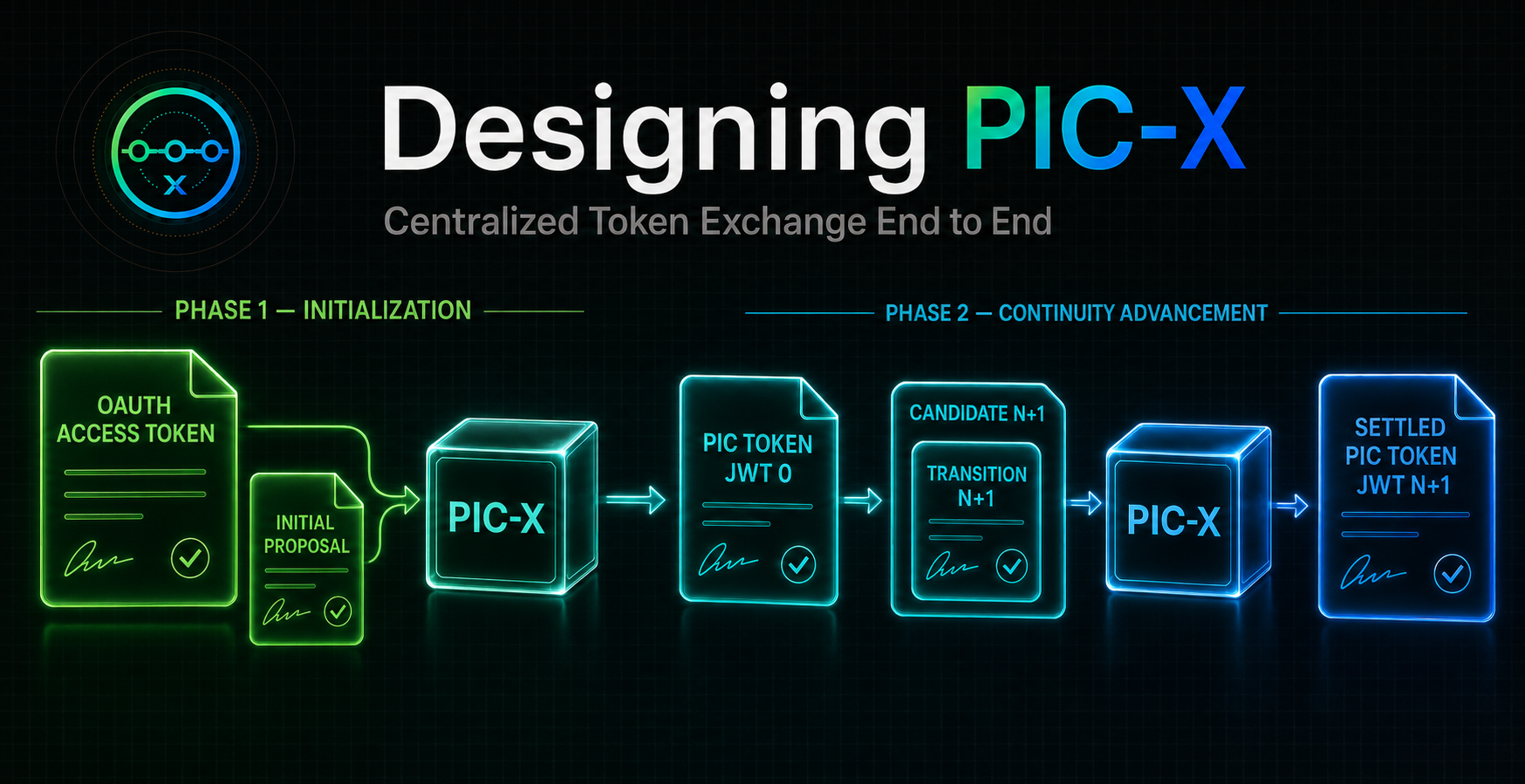
PIC Profile 0.2 defines centralized PIC-X-mediated authority continuity.
This walkthrough follows one sensitive-document execution from OAuth authority into PIC Token JWT 0, then through two workload-produced candidate transitions.
OAuth authority
        |
        v
PCA 0
{ read document-42, save }
        |
        | Worker 1 reads document-42
        | remove read authority
        v
PCA 1
{ save }
        |
        | Worker 2 stores the result
        | remove save authority
        v
PCA 2
{ no execution invariants }
Cryptographic byte values, compact tokens, signatures, hashes, and COSE byte strings below are illustrative. The structure and field semantics follow Profile 0.2.
1. Starting Authority
Incoming OAuth access token, decoded:
{
  "header": {
    "alg": "ES256",
    "kid": "idp-key-1",
    "typ": "at+jwt"
  },
  "payload": {
    "iss": "https://idp.example.com",
    "sub": "user-123",
    "aud": "pic-x",
    "iat": 1786700400,
    "exp": 1786704000,
    "scope": "documents:read:document-42 storage:save"
  }
}
Only two OAuth scopes matter here:
documents:read:document-42
storage:save
The self-describing Initial Continuity Proposal supplies execution constraints:
{
  "type": "https://pic-protocol.org/definitions/proposal-types/continuity-initial",
  "executionContract": {
    "corporation": "ACME",
    "department": "sensitive-documents"
  }
}
The execution contract constrains execution. It does not grant authority. The type member identifies the proposal definition/schema before the remaining proposal payload is interpreted.
Initialization uses RFC 8693 Token Exchange:
POST /realms/acme/token HTTP/1.1
Host: pic-x.example.com
Content-Type: application/x-www-form-urlencoded

grant_type=urn:ietf:params:oauth:grant-type:token-exchange
&subject_token=<oauth-access-token>
&subject_token_type=urn:ietf:params:oauth:token-type:access_token
&requested_token_type=https://pic-protocol.org/definitions/token-types/pic
&continuity_proposal=<base64url-self-describing-initial-proposal>
2. OAuth -> PCA 0
PIC-X validates the OAuth token and maps the scopes into the logical PCA.
The JSON below is the readable logical PCA. The signed checkpoint is encoded as the canonical Indexed Authority Map inside a CBOR/COSE COSE_Sign1 object.
{
  "execution": {
    "invariants": [
      {
        "scope": "documents:read:document-42",
        "operation": "read",
        "resourceType": "documents",
        "resourceId": "document-42"
      },
      {
        "scope": "storage:save",
        "operation": "save",
        "resourceType": "storage",
        "resourceId": "*"
      }
    ],
    "contract": {
      "corporation": "ACME",
      "department": "sensitive-documents"
    }
  }
}
Canonicalization:
logical execution.invariants
        |
        | sort by scope, operation, resourceType, resourceId
        v
section-local invariant indexes

logical execution.contract
        |
        | sort by canonical key using Unicode code point order
        v
section-local execution_contract indexes
identity_context is omitted in this example.
PCA 0 Indexed Authority Map:
{
  "invariants": {
    0: ["documents:read:document-42", "read", "documents", "document-42"],
    1: ["storage:save", "save", "storage", "*"]
  },

  "execution_contract": {
    0: ["corporation", "ACME"],
    1: ["department", "sensitive-documents"]
  }
}
corporation sorts before department, so the execution-contract indexes are 0 and 1 in that order.
PCA 0 payload:
{
  "profile": "https://pic-protocol.org/profiles/0.2",
  "position": 0,
  "context_of_authority": {
    "invariants": {
      0: ["documents:read:document-42", "read", "documents", "document-42"],
      1: ["storage:save", "save", "storage", "*"]
    },
    "execution_contract": {
      0: ["corporation", "ACME"],
      1: ["department", "sensitive-documents"]
    }
  },
  "challenge": {
    "next_challenge": h'7b6f6d3c9f2a8d11c4e3b87a60d51792'
  }
}
PIC PCA COSE 0, structural view:
18([
  / protected / h'a10126',
  / unprotected / {},
  / payload / <encoded PIC PCA 0 payload bytes, truncated>,
  / signature / h'c4e7f9e3a6a714610a9b8d13fc95fb17f2e8cc9f9a7c78c81fd6165aaeddbb570b25e39c8e7b2dd3c4f443289b8fdf58ce2bb76df29b3cb8d736210e8a44f8d1'
])
Exact CBOR integer labels and RFC 9596 typ values remain profile/spec-defined where the source article defers them; diagnostic views use textual field names.
3. Settled PIC Token JWT 0
PIC-X signs a settled Continuity whose root carries the exact signed PIC PCA COSE 0 bytes and their SHA-256 hash:
PIC PCA COSE 0 bytes
        |
        | SHA-256 over exact signed bytes
        v
pca_hash = h'9c0a8f3f4f9a05e6a6c0d93b3132e9b2f28a7bbd0b50b9d98f58f10a5d9d2e61'
Do not hash the decoded payload or diagnostic notation.
Settled PIC Continuity COSE 0 payload, structural view:
{
  "profile": "https://pic-protocol.org/profiles/0.2",
  "root": {
    "pca_hash": h'9c0a8f3f4f9a05e6a6c0d93b3132e9b2f28a7bbd0b50b9d98f58f10a5d9d2e61',
    "pca": <exact signed PIC PCA COSE 0 bytes, truncated>
  },
  "transitions": null
}
root.pca is the exact signed PIC PCA COSE 0 bytes. transitions = null means settled, with no pending advancement.
Settled PIC Continuity COSE 0 COSE_Sign1 structural view:
18([
  / protected / h'a10126',
  / unprotected / {},
  / payload / <encoded settled PIC Continuity COSE 0 payload bytes, truncated>,
  / signature / h'e7c5d82fcd59e7d2c68bd1ab8fd8fb8312690f8bb389f78eaef5c55358b4ad0c5dbefbf3212b0129d2b5386304e9090f33f6fffd9a7839b8b561c6e66ebef028'
])
PIC Token JWT 0 payload:
{
  "iss": "https://pic-x.example.com/realms/acme",
  "sub": "pic-execution-123",
  "aud": "document-pipeline",
  "iat": 1786700400,
  "exp": 1786704000,
  "jti": "pic-token-01J8K0PCA0",
  "profile": "https://pic-protocol.org/profiles/0.2",
  "pic": {
    "root": "<base64url exact settled PIC Continuity COSE 0 bytes, truncated>"
  }
}
pic.root is Base64url of the exact binary settled PIC Continuity COSE 0 bytes.
PIC PCA COSE 0
        |
        v
settled PIC Continuity COSE 0
        |
        v
realm-signed PIC Token JWT 0
4. Two Workloads
Hard format boundary:
OAuth Access Token
= JWT/JWS

Initial Continuity Proposal
= JSON

SD-JWT Proof of Relationship evidence
= RFC 9901 SD-JWT
= Issuer-signed JWT/JWS + selected Disclosures
= textual JOSE serialization

PIC Token
= JWT/JWS

PIC PCA COSE
= CBOR/COSE

PIC Continuity COSE
= CBOR/COSE

PIC Continuity Transition COSE
= CBOR/COSE
The Transition is CBOR/COSE. Its proof_of_relationship field is a typed container. In this Profile 0.2 walkthrough, proof_of_relationship.type = "sd-jwt" and proof_of_relationship.evidence is a CBOR bstr containing the exact UTF-8 bytes of the textual SD-JWT presentation string.
Signer roles stay separate:
SD-JWT Issuer / attestation issuer
→ signs workload relationship evidence as JWT/JWS

Holder / workload runtime
→ selects Disclosures and signs candidate PIC artifacts

Verifier / PIC-X
→ validates SD-JWT issuer signature, Disclosures and candidate PIC signatures

PIC realm signer
→ signs the new PIC PCA COSE checkpoint, settled PIC Continuity COSE and settled PIC Token JWT
These are distinct protocol roles.
The disclosed workload attributes below belong to the illustrative deployment schema. Profile 0.2 does not define these claim names, and their presence in the PoR does not by itself establish execution-contract conformance.
PoR evidence / validation
→ supports the accepted workload relationship and identifies accepted workload key material

Transition signature
→ proves control of the workload private key

executor_evidence / conformance validation
→ separate when required
The SD-JWT credential alone does not establish Proof of Continuity. In Profile 0.2, the configured PoR issuer/schema and the concrete relationship checks are assumed to soundly witness the abstract single-hop PoR relation. A transition is accepted only when that PoR relation holds and the separate applicable validation checks, including non-expansion, evidence or conformance, request binding, revocation, and policy, also succeed. The PIC mathematical model and Lean refinement prove safety under the PoR bridge assumption; they do not prove the cryptographic soundness of that deployment-specific construction.
This walkthrough uses RFC 9901’s cnf.jwk form to carry the workload public verification key. PIC Profile 0.2 requires the selected PoR schema to bind or identify that key; it does not make this exact claim path normative here.
Issuer issues many attributes
        |
        v
Holder receives all relevant Disclosures
        |
        | selects only what is required for this hop
        v
PIC-X receives a minimized SD-JWT presentation
The Holder presents only the Disclosures required by the selected trust/conformance policy for that operation. All other selectively disclosable attributes remain undisclosed.
Worker 1
The Issuer starts from workload attributes such as:
{
  "corporation": "ACME",
  "department": "sensitive-documents",
  "workload_role": "document-reader",
  "service": "document-processing",
  "clearance": "sensitive",
  "reader_region": "eu-west",
  "deployment_environment": "production",
  "build_id": "reader-2026.08.14",
  "host_class": "confidential-compute",
  "internal_cluster": "docs-cluster-17"
}
For this walkthrough, those ten attributes are selectively disclosable. Validity claims and cnf.jwk are permanently disclosed. No decoy digests are used.
Each selectively disclosable claim uses a different Base64url salt with at least 128 bits of entropy. The displayed salts are illustrative.
Disclosure contents for an object-property claim are a JSON array:
["f0UUCvMSycSUXaVfuiDWAA","corporation","ACME"]
The Disclosure is the Base64url encoding of that UTF-8 JSON array, without padding:
D_corporation =
WyJmMFVVQ3ZNU3ljU1VYYVZmdWlEV0FBIiwiY29ycG9yYXRpb24iLCJBQ01FIl0
Digest calculation:
Disclosure contents
        |
        | UTF-8 JSON serialization
        v
Base64url Disclosure string
        |
        | US-ASCII bytes
        | SHA-256
        v
digest bytes
        |
        | Base64url without padding
        v
_sd digest string
Example second Disclosure:
Disclosure contents =
["E54m03bpDTSeWfZOQ-1wVw","department","sensitive-documents"]

D_department =
WyJFNTRtMDNicERUU2VXZlpPUS0xd1Z3IiwiZGVwYXJ0bWVudCIsInNlbnNpdGl2ZS1kb2N1bWVudHMiXQ
The Issuer-signed JWT is a JWS. The compact serialization is omitted here; the decoded payload contains digest strings, not cleartext names or values for selectively disclosable claims:
{
  "iss": "https://attestation.example.com",
  "iat": 1786700500,
  "exp": 1786704100,
  "_sd_alg": "sha-256",
  "_sd": [
    "3CNTPr87PwmN0oW4tNoyswYdsgSUCc6R2B1JSC7I6pI",
    "62rjCYviAli2R9bOU8etQ2DWjOGJETL4L2_Vewqzl8I",
    "6g3ffib_cNuBmTs4R3AyvyGK8dcZIteeRtw8yPAmDCU",
    "POtp4eFO4TReywR0yahpwryzSO_dLgiK6Y8lbmdb7SA",
    "P_9_ewlbKJ-ddpy7LivbSPPCYO219Si_0pAj-iElZJQ",
    "Xn7kw6_wekrrpvjPLcrMOQWwVzvVgSsMla6892-qlx8",
    "cmQs8BFsB9ejZrCaaXNbiq0iZW19oG0bTx-N5wLGm24",
    "mzeyOGQIao4tTM8WvLC-qG2hQa1oxmCYl-wjz7GS0yo",
    "vh7enFAhHilhjEs409goqcE44UWGuIgzcMNhDih_Cgc",
    "yjForVdxBM3AP4GqLrN715bZbnrJ9XqzanJ4WeW5Ru4"
  ],
  "cnf": {
    "jwk": {
      "kty": "EC",
      "crv": "P-256",
      "kid": "worker-1-key",
      "x": "AbZzIerBJYtaxamji_Z4jT3oAuhAw_p-IPnIHFQ_YsM",
      "y": "LxUSbSzHe7-a3WbnZqMTfpRo_2VdTY_ugsn5xW9OWtU"
    }
  }
}
The _sd values above are ten real digest commitments for the ten issued Disclosures. They are sorted alphanumerically so their order does not reveal the original claim order.
Issuance to Worker 1:
Issuer
        |
        v
Issuer-signed JWT + all issued Disclosure strings
        |
        v
Holder / Worker 1
The Holder receives the issued Disclosure strings, but presents only the two required by the selected trust/conformance policy for this hop.
Worker 1 presents only selected Disclosures:
issued selectively disclosable attributes: 10

presented to PIC-X: 2
├── corporation
└── department

not presented: 8
├── workload_role
├── service
├── clearance
├── reader_region
├── deployment_environment
├── build_id
├── host_class
└── internal_cluster
The not presented list is explanatory documentation, not wire data visible to PIC-X.
The omitted Disclosures, including their salts, are not transmitted to PIC-X. For omitted object-property claims, the cleartext claim names and values are not transmitted either. PIC-X learns only the selected Disclosures plus permanently disclosed claims such as issuer, validity information and cnf.jwk; the number of digest commitments may still reveal some metadata when no decoys are used.
SD-JWT presentation sent to PIC-X:
<Issuer-signed JWT>
~WyJmMFVVQ3ZNU3ljU1VYYVZmdWlEV0FBIiwiY29ycG9yYXRpb24iLCJBQ01FIl0
~WyJFNTRtMDNicERUU2VXZlpPUS0xd1Z3IiwiZGVwYXJ0bWVudCIsInNlbnNpdGl2ZS1kb2N1bWVudHMiXQ
~
The bare SD-JWT presentation ends with ~. No KB-JWT is appended in this Profile 0.2 walkthrough.
Note: Profile 0.2 does not append a separate SD-JWT KB-JWT for continuity advancement. The workload instead proves control of the private key corresponding to the verification key accepted from the PoR by signing the PIC Continuity Transition COSE, the candidate PIC Continuity COSE, and the candidate PIC Token JWT. These workload signatures belong to the PIC candidate-validation flow and are not RFC 9901 KB-JWTs.
Processed SD-JWT Payload after RFC 9901 verification and Disclosure processing:
{
  "iss": "https://attestation.example.com",
  "iat": 1786700500,
  "exp": 1786704100,
  "cnf": {
    "jwk": {
      "kty": "EC",
      "crv": "P-256",
      "kid": "worker-1-key",
      "x": "AbZzIerBJYtaxamji_Z4jT3oAuhAw_p-IPnIHFQ_YsM",
      "y": "LxUSbSzHe7-a3WbnZqMTfpRo_2VdTY_ugsn5xW9OWtU"
    }
  },
  "corporation": "ACME",
  "department": "sensitive-documents"
}
Undisclosed claims are absent from the Processed SD-JWT Payload.
Issuer private key
        |
        v
Issuer-signed SD-JWT/JWS
├── _sd digest commitments
├── validity claims
└── cnf.jwk -> Worker 1 public key
        |
        | Holder selects Disclosures
        v
RFC 9901 SD-JWT presentation
        |
        | exact UTF-8 bytes become Transition.proof_of_relationship.evidence
        | Transition.proof_of_relationship.type = "sd-jwt"
        v
Worker 1 runtime
        (private key matching cnf.jwk)
        |
        ├── signs PIC Continuity Transition COSE
        ├── signs candidate PIC Continuity COSE
        └── signs candidate PIC Token JWT
Worker 2
Worker 2 uses the same RFC 9901 mechanism with its own SD-JWT and key pair.
The Issuer starts from storage workload attributes such as:
{
  "corporation": "ACME",
  "department": "sensitive-documents",
  "workload_role": "storage-writer",
  "service": "secure-storage",
  "storage_class": "sensitive",
  "storage_region": "eu-central",
  "storage_namespace": "acme-sensitive-documents",
  "retention_profile": "protected-30d",
  "replication_mode": "dual-region",
  "internal_cluster": "storage-cluster-09"
}
issued selectively disclosable attributes: 10
selected disclosures: 2
undisclosed disclosures: 8

presented to PIC-X
├── corporation
└── department

not presented
├── workload_role
├── service
├── storage_class
├── storage_region
├── storage_namespace
├── retention_profile
├── replication_mode
└── internal_cluster
The not presented list is explanatory documentation, not wire data visible to PIC-X.
Issuer-signed JWT payload:
{
  "iss": "https://attestation.example.com",
  "iat": 1786700600,
  "exp": 1786704200,
  "_sd_alg": "sha-256",
  "_sd": [
    "3n0NhmZG6-aCGQ4rmfAzwDSHjdVXK93gl23p0DrE2NE",
    "5jS4X8__1_bsn9BIGOHMFaaSAcrFC4QapluetUD3q9Y",
    "7LZcdUaO9sx9SPw6HOLKucCgsLzgU1lXRUH-cyPMgZA",
    "HLCCyUiFz4hWQc9UEs3CxJ0jJs3aWQsEKCDyu1WDSHk",
    "Q0uqe1mYb0FWc8HHwxrXTAhvDF9r8yHiU68uB5ZhfvI",
    "Qe7z-9SG7SSc4V4XQFsYtAVbBKKma-DkGf2VpVrXf9w",
    "WZL2Zh1LPIk4_CKq8XS8cifzcn9Acflj2kbA-j56R8E",
    "YdzFXlL-LbeoTudnQMtMmjI8jHe6GNQbLDqkXI1SoxA",
    "xjMzpQA6cwywHrkPgKYcSEZ0wiP0WgvPRmElTrAXQfE",
    "yOK0mbTnJYzeTizNrQU683ZcK6C5GtjsHnw_3hwop5E"
  ],
  "cnf": {
    "jwk": {
      "kty": "EC",
      "crv": "P-256",
      "kid": "worker-2-key",
      "x": "qVrnRMgFK2zqdeguigyDOcX9p3PzUXTzey5VRIdSKgw",
      "y": "BHCfKNUuGjvLYow1uxoz43CpyKKeM1_fXxrnNC3GMqE"
    }
  }
}
The _sd values above are ten real digest commitments for the ten issued Disclosures, sorted independently of the source claim order.
Selected Disclosure contents and strings:
Disclosure contents =
["LfYWIczToLIsjWrGf3BSWw","corporation","ACME"]

D_corporation =
WyJMZllXSWN6VG9MSXNqV3JHZjNCU1d3IiwiY29ycG9yYXRpb24iLCJBQ01FIl0

Disclosure contents =
["PjCyltFjXbt5b7sr_OHlHA","department","sensitive-documents"]

D_department =
WyJQakN5bHRGalhidDViN3NyX09IbEhBIiwiZGVwYXJ0bWVudCIsInNlbnNpdGl2ZS1kb2N1bWVudHMiXQ
Presentation sent to PIC-X:
<Issuer-signed JWT>
~WyJMZllXSWN6VG9MSXNqV3JHZjNCU1d3IiwiY29ycG9yYXRpb24iLCJBQ01FIl0
~WyJQakN5bHRGalhidDViN3NyX09IbEhBIiwiZGVwYXJ0bWVudCIsInNlbnNpdGl2ZS1kb2N1bWVudHMiXQ
~
The other eight Disclosure strings and salts are not sent to PIC-X.
Selected Worker 2 Processed SD-JWT Payload:
{
  "iss": "https://attestation.example.com",
  "iat": 1786700600,
  "exp": 1786704200,
  "cnf": {
    "jwk": {
      "kty": "EC",
      "crv": "P-256",
      "kid": "worker-2-key",
      "x": "qVrnRMgFK2zqdeguigyDOcX9p3PzUXTzey5VRIdSKgw",
      "y": "BHCfKNUuGjvLYow1uxoz43CpyKKeM1_fXxrnNC3GMqE"
    }
  },
  "corporation": "ACME",
  "department": "sensitive-documents"
}
Worker 2 runtime
        |
        └── holds the private key matching worker-2-key
PIC Transition signatures are not RFC 9901 KB-JWTs. Current Profile 0.2 uses workload signatures on PIC candidate artifacts instead of requiring a separate SD-JWT KB-JWT.
5. Worker 1: Read And Attenuate
Worker 1 receives PIC Token JWT 0.
Flow at a glance:
PCA 0
{ read document-42, save }

        |
        | Worker 1
        | reads document-42
        | removes read authority
        v

PCA 1
{ save }
Current PCA 0 invariant indexes:
index 0 -> documents:read:document-42
index 1 -> storage:save
Worker 1 reads document-42 and proposes removing invariant index 0.
byte_index = floor(0 / 8) = 0
bit_index  = 0 mod 8      = 0
mask       = 1 << 0       = 0x01

remove_bitmap = h'01'
before
0 -> documents:read:document-42
1 -> storage:save

remove_bitmap h'01'
          |
          v

after
storage:save
Bits are numbered least-significant-bit first. Trailing zero bytes are omitted. A set bit for a non-existent predecessor index is invalid.
Transition 1 payload:
{
  "profile": "https://pic-protocol.org/profiles/0.2",
  "position": 1,

  "predecessor": {
    "type": "pca",
    "hash": h'9c0a8f3f4f9a05e6a6c0d93b3132e9b2f28a7bbd0b50b9d98f58f10a5d9d2e61'
  },

  "challenge": {
    "previous_challenge": h'7b6f6d3c9f2a8d11c4e3b87a60d51792',
    "next_challenge": h'91bbdf14277fc1d41a3e42ea0f764d8a'
  },

  "attenuations": {
    "invariants": {
      "remove_bitmap": h'01'
    }
  },

  "proof_of_relationship": {
    "type": "sd-jwt",
    "evidence": <exact UTF-8 bytes of Worker 1 SD-JWT presentation string>
  }
}
The value inside proof_of_relationship.evidence is not a COSE-encoded SD-JWT. It is the byte-string representation of the exact textual RFC 9901 SD-JWT presentation. The proof_of_relationship.type value "sd-jwt" tells PIC-X how to parse and validate that evidence.
Transition 1 COSE:
18([
  / protected / h'a10126',
  / unprotected / {},
  / payload / <encoded Transition 1 payload bytes, truncated>,
  / signature / h'f876cbf04e71e0fd6976dd6f9bfec88d28372493b0446c39463becfb06980a4c24477b0df21eb7f84d95c8533b56939dba77c95b5b2c091ee67afbaf04394e11'
])
Candidate Continuity payload:
{
  "profile": "https://pic-protocol.org/profiles/0.2",
  "root": {
    "pca_hash": h'9c0a8f3f4f9a05e6a6c0d93b3132e9b2f28a7bbd0b50b9d98f58f10a5d9d2e61',
    "pca": <exact signed PIC PCA COSE 0 bytes, truncated>
  },
  "transitions": [
    <exact signed Transition 1 COSE bytes, truncated>
  ]
}
Candidate PIC Token JWT payload:
{
  "aud": "pic-x",
  "iat": 1786700700,
  "profile": "https://pic-protocol.org/profiles/0.2",
  "pic": {
    "root": "<base64url exact workload-signed candidate Continuity COSE bytes, truncated>"
  }
}
Candidate iss is optional in centralized Profile 0.2. If present, it is identity metadata, not the source of cryptographic trust.
Worker 1 private key
   |
   +--> Transition 1 COSE signature
   +--> candidate Continuity COSE signature
   `--> candidate PIC Token JWT JWS signature
These are three distinct signed objects using the same workload private key.
PIC-to-PIC advancement uses Token Exchange with the candidate as subject_token:
POST /realms/acme/token HTTP/1.1
Host: pic-x.example.com
Content-Type: application/x-www-form-urlencoded

grant_type=urn:ietf:params:oauth:grant-type:token-exchange
&subject_token=<workload-signed-candidate-pic-token-jwt>
&subject_token_type=https://pic-protocol.org/definitions/token-types/pic
&requested_token_type=https://pic-protocol.org/definitions/token-types/pic
Current Profile 0.2 PIC-to-PIC advancement omits continuity_proposal.
PIC-X receives the candidate as untrusted input:
parse PIC JWT / Continuity / Transition
        |
        +-- validate proof_of_relationship.type = "sd-jwt"
        +-- parse proof_of_relationship.evidence as Issuer-signed SD-JWT + selected Disclosures
        +-- verify issuer JWS signature and issuer trust
        +-- validate _sd_alg
        +-- Base64url decode each selected Disclosure
        +-- validate Disclosure structure and digest matches
        +-- reject unreferenced Disclosures and duplicate digest use
        +-- reconstruct Processed SD-JWT Payload
        +-- validate required validity claims
        +-- obtain Worker 1 public key from cnf.jwk
        +-- verify three workload signatures
        +-- verify trusted PCA 0 hash, position and challenge
        +-- apply remove_bitmap h'01'
        +-- enforce execution-contract constraints
        +-- validate executor evidence / conformance when required
        +-- validate revocation and local policy
        +-- verify non-expansion
        |
        v
materialize PCA 1
The Transition signature proves control of the PoR-bound workload private key. It is not Proof of Continuity by itself.
PCA 1 Materialized
Apply attenuation:
"invariants": {
  0: ["documents:read:document-42", "read", "documents", "document-42"],
  1: ["storage:save", "save", "storage", "*"]
}
remove_bitmap = h'01'
Resulting logical PCA:
{
  "execution": {
    "invariants": [
      {
        "scope": "storage:save",
        "operation": "save",
        "resourceType": "storage",
        "resourceId": "*"
      }
    ],
    "contract": {
      "corporation": "ACME",
      "department": "sensitive-documents"
    }
  }
}
PCA 1 is a new checkpoint with a new section-local Indexed Authority Map:
{
  "invariants": {
    0: ["storage:save", "save", "storage", "*"]
  },
  "execution_contract": {
    0: ["corporation", "ACME"],
    1: ["department", "sensitive-documents"]
  }
}
PCA 1 position = 1
PCA 1 challenge.next_challenge = h'91bbdf14277fc1d41a3e42ea0f764d8a'
Realm-signed PIC PCA COSE 1 payload:
{
  "profile": "https://pic-protocol.org/profiles/0.2",
  "position": 1,
  "context_of_authority": {
    "invariants": {
      0: ["storage:save", "save", "storage", "*"]
    },
    "execution_contract": {
      0: ["corporation", "ACME"],
      1: ["department", "sensitive-documents"]
    }
  },
  "challenge": {
    "next_challenge": h'91bbdf14277fc1d41a3e42ea0f764d8a'
  }
}
Settled result:
realm-signed PIC PCA COSE 1
        |
        v
realm-signed settled PIC Continuity COSE 1
transitions = null
        |
        v
realm-signed PIC Token JWT 1
The read privilege is gone and cannot reappear later in the same lineage branch. A sibling branch continued from PCA 0 may still carry it; terminating the predecessor checkpoint itself is a revocation decision.
6. Worker 2: Save And Attenuate
Worker 2 receives PIC Token JWT 1 and stores the result.
Flow at a glance:
PCA 1
{ save }

        |
        | Worker 2
        | saves the document
        | removes save authority
        v

PCA 2
{ }
PCA 1 invariant indexes:
index 0 -> storage:save
Remove index 0 from the new checkpoint:
byte_index = floor(0 / 8) = 0
bit_index  = 0 mod 8      = 0
mask       = 1 << 0       = 0x01

remove_bitmap = h'01'
The bitmap is again h'01' because PCA 1 was re-materialized and storage:save is now section-local index 0.
PCA 1 hash and challenge:
pca_1_hash = h'4b7f3d61ae8ef7c2f001d8b545d0cfbd019e8dbbc678f3c4f0edcdf1f812c683'
pca_1_next_challenge = h'91bbdf14277fc1d41a3e42ea0f764d8a'
Transition 2 payload:
{
  "profile": "https://pic-protocol.org/profiles/0.2",
  "position": 2,

  "predecessor": {
    "type": "pca",
    "hash": h'4b7f3d61ae8ef7c2f001d8b545d0cfbd019e8dbbc678f3c4f0edcdf1f812c683'
  },

  "challenge": {
    "previous_challenge": h'91bbdf14277fc1d41a3e42ea0f764d8a',
    "next_challenge": h'37c5915d42ef8d0bbd3ac513798f2c20'
  },

  "attenuations": {
    "invariants": {
      "remove_bitmap": h'01'
    }
  },

  "proof_of_relationship": {
    "type": "sd-jwt",
    "evidence": <exact UTF-8 bytes of Worker 2 SD-JWT presentation string>
  }
}
Worker 2 signs the same three object types with its own private key:
Worker 2 private key
   |
   +--> Transition 2 COSE signature
   +--> candidate Continuity COSE signature
   `--> candidate PIC Token JWT JWS signature
PIC-X applies the same Profile 0.2 validation pattern: proof_of_relationship.type = "sd-jwt", RFC 9901 SD-JWT verification from proof_of_relationship.evidence, accepted Worker 2 public key, three workload signatures, trusted PCA 1, predecessor hash, position, challenge continuity, attenuation, execution-contract constraints, executor evidence/conformance when required, revocation, policy, and non-expansion.
PCA 2 Materialized
Before:
"invariants": {
  0: ["storage:save", "save", "storage", "*"]
}
Apply:
remove_bitmap = h'01'
Resulting logical PCA:
{
  "execution": {
    "invariants": [],
    "contract": {
      "corporation": "ACME",
      "department": "sensitive-documents"
    }
  }
}
The existing Profile 0.2 source article does not define a separate empty-section encoding rule here. The diagnostic view below shows the semantic materialized authority map with no invariant entries:
{
  "invariants": {},
  "execution_contract": {
    0: ["corporation", "ACME"],
    1: ["department", "sensitive-documents"]
  }
}
An empty invariant map means no remaining executable authority. The PCA checkpoint still exists, and the execution contract remains.
Note: This attenuation removes executable authority from this selected lineage branch only. It does not revoke the predecessor PCA or retroactively invalidate another otherwise-valid continuation derived from that predecessor. If the predecessor must no longer be accepted as the basis for further continuations, that is a revocation decision and must be enforced through the applicable PIC revocation mechanism. This example demonstrates attenuation to zero executable authority, not revocation.
Realm-signed PIC PCA COSE 2 payload, shown with the same readable empty-map convention:
{
  "profile": "https://pic-protocol.org/profiles/0.2",
  "position": 2,
  "context_of_authority": {
    "invariants": {},
    "execution_contract": {
      0: ["corporation", "ACME"],
      1: ["department", "sensitive-documents"]
    }
  },
  "challenge": {
    "next_challenge": h'37c5915d42ef8d0bbd3ac513798f2c20'
  }
}
Final settled result:
realm-signed PIC Token JWT 2
└── settled PIC Continuity COSE 2
    ├── root.pca = exact signed PIC PCA COSE 2 bytes
    └── transitions = null
Signer Roles
SD-JWT / attestation Issuer
(private signing key)
        |
        v
Issuer-signed SD-JWT/JWS
├── validity claims
├── _sd digest commitments
└── cnf.jwk -> Worker public key
        |
        | Holder selects minimum required Disclosures
        v
privacy-minimized RFC 9901 SD-JWT presentation
        |
        | exact UTF-8 bytes become Transition.proof_of_relationship.evidence
        | Transition.proof_of_relationship.type = "sd-jwt"
        v
Worker runtime
(private key matching cnf.jwk)
        |
        ├── signs PIC Transition COSE
        ├── signs candidate PIC Continuity COSE
        └── signs candidate PIC Token JWT
        |
        v
PIC-X
        |
        ├── validates issuer JWS
        ├── validates selected Disclosures
        ├── obtains Worker public key
        ├── verifies candidate signatures
        ├── validates PCA / hash / position / challenge
        ├── applies remove_bitmap
        ├── checks policy / revocation / conformance
        └── materializes next PCA
        |
        v
PIC realm
        |
        ├── signs new PIC PCA COSE
        ├── signs settled PIC Continuity COSE
        └── signs settled PIC Token JWT
End-To-End View
OAuth Access Token
├── documents:read:document-42
└── storage:save
        +
Initial Continuity Proposal
├── type = https://pic-protocol.org/definitions/proposal-types/continuity-initial
├── corporation = ACME
└── department = sensitive-documents
        |
        v
PCA 0
├── position = 0
└── invariants
    ├── 0 -> documents:read:document-42
    └── 1 -> storage:save
        |
        | Worker 1 READ
        | remove_bitmap h'01'
        v
PCA 1
├── position = 1
└── invariants
    └── 0 -> storage:save
        |
        | Worker 2 SAVE
        | remove_bitmap h'01'
        v
PCA 2
├── position = 2
└── invariants = {}
In this OAuth-based initialization flow, PIC authority is derived from the validated OAuth access token under the Exchange Profile and local policy, constrained by the execution contract, then checkpointed into PCA 0. Each validated continuation can only preserve or reduce that authority. Different workloads may continue the lineage, but none may replenish authority from privileges they independently hold.